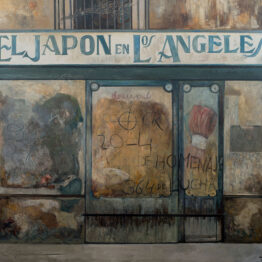


Those of you who have travelled to Flanders in the footsteps of its great masters — and perhaps some of you have done so following the itinerary we published a while ago on masdearte — will know that cities such as Ghent, Bruges, Antwerp, Leuven, Mechelen and Brussels never disappoint. This time, however, we wanted to venture beyond those cities and explore a part of Flanders we hadn’t visited before: the Limburg region. Here, the heritage is more scattered, the distances encourage you to keep moving, and much of the route takes you through woods, fields and former mining areas. We set out to discover it so we could tell you all about it and, just as we did on that first trip, we travelled by bike — by far the best way to get around here.
Our route begins in Hasselt and ends a few days later in Sint-Truiden, after passing through Genk, Hoge Kempen National Park, the Meuse Valley, Oud-Rekem, Tongeren and the hills of Haspengouw. But this isn’t a fixed itinerary. Depending on how many days you have or the pace you want to set, you can easily adapt it, adding extra days or taking detours according to your interests. We soon realised that much of the appeal lies precisely in what you come across along the way. Wine lovers, take note: the vineyard areas might tempt you to linger a little longer than planned…
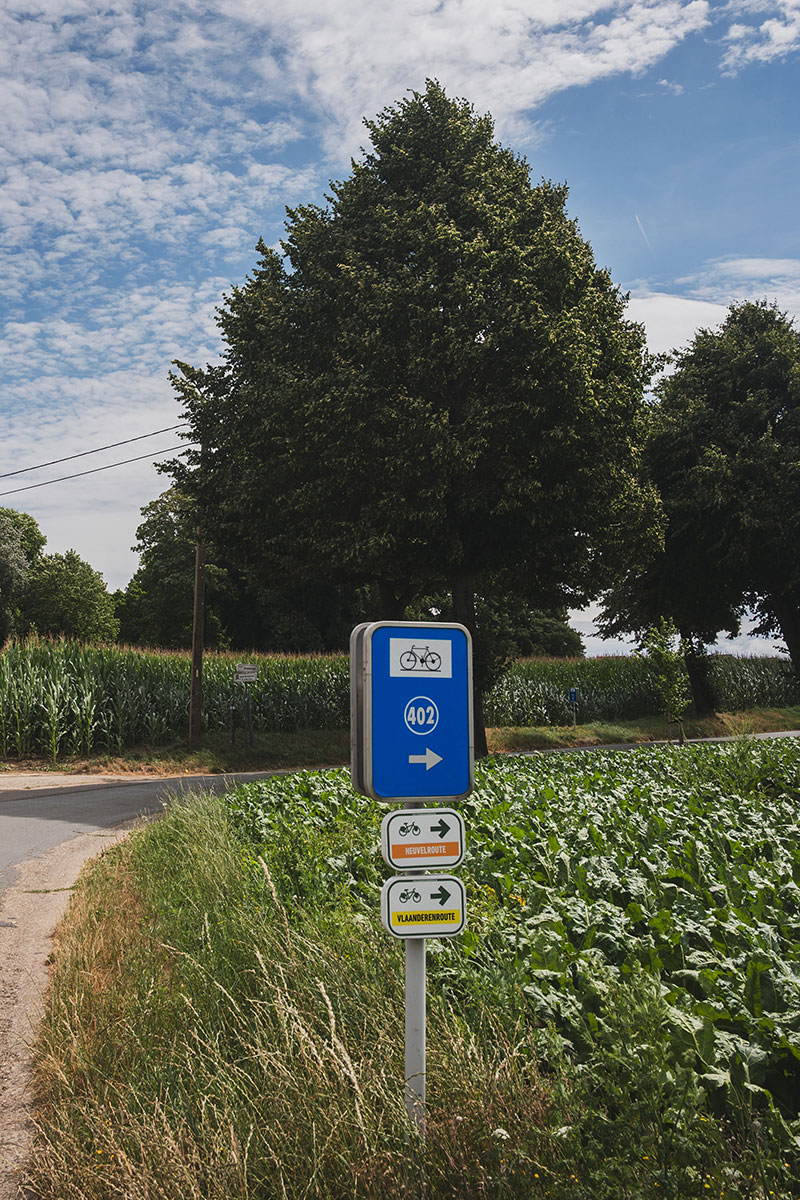
Example of signage for the cycle network in Flanders
Getting there is surprisingly easy. From Brussels Airport, you can reach Hasselt by train in just over 30 minutes. This will be our starting point and where we’ll hire the bikes. At the end of the route, we’ll leave them at Sint-Truiden station before taking the train back to the airport. The logistics are simple, leaving you free to concentrate on what really matters: enjoying the ride.
As we mentioned in our guide to Flanders’ art cities, you don’t need to be particularly fit for this route either, especially if you opt for electric bikes, now the most common choice at almost all rental shops. We used Biking Fietsshop, which allowed us to collect the bikes at the start of the route and return them at the end, although there are several other rental companies in the city. Expect to pay around 30 euros per day. Much of Limburg is completely flat. There are a few slopes further south and the wind can sometimes make things a little harder, but electric bikes virtually eliminate any difficulty.
One of the most striking features of the entire route is the superb cycling infrastructure. There are kilometres upon kilometres of cycle lanes separated from traffic, farm tracks and well-maintained paths, junctions designed with cyclists in mind, and a system of numbered waypoints that allows you to link one point to another by following very clear signs. Even so, we always keep the route downloaded on Komoot. It gives us peace of mind and is particularly useful when we decide to change course on the spur of the moment.
Once you’re on the road, you get the feeling that everything has been designed to make cycling a pleasure rather than a worry. It is worth planning ahead a little, though, as there are long stretches through the countryside and very small villages where it isn’t always easy to find somewhere to stop for something to eat or drink. Having water and some nuts in our panniers came in handy on more than one occasion.
HASSELT. A VISIT TO THE CITY BEFORE SETTING OFF
The capital of Limburg is a good place to begin to understand the character of the region. Its historic centre retains the intimate scale of a city whose past was linked to the former County of Loon, but which today has a particular focus on design and contemporary creativity. Het Stadsmus offers an introduction to its history, while other highlights include the Fashion Museum and the museum dedicated to jenever, the juniper-based spirit closely linked to the city’s identity. There is also plenty of street art, with murals scattered throughout the city centre to discover as you wander around.
For our journey, however, one institution is particularly significant: Z33, House for Contemporary Art, Design and Architecture. It is worth remembering the name, as it will come up again later. Its activities extend beyond the galleries of the building designed by Italian architect Francesca Torzo and across Limburg through a number of public art projects. Some of the works we’ll come across along the Meuse or among the fields of Haspengouw originated right here.
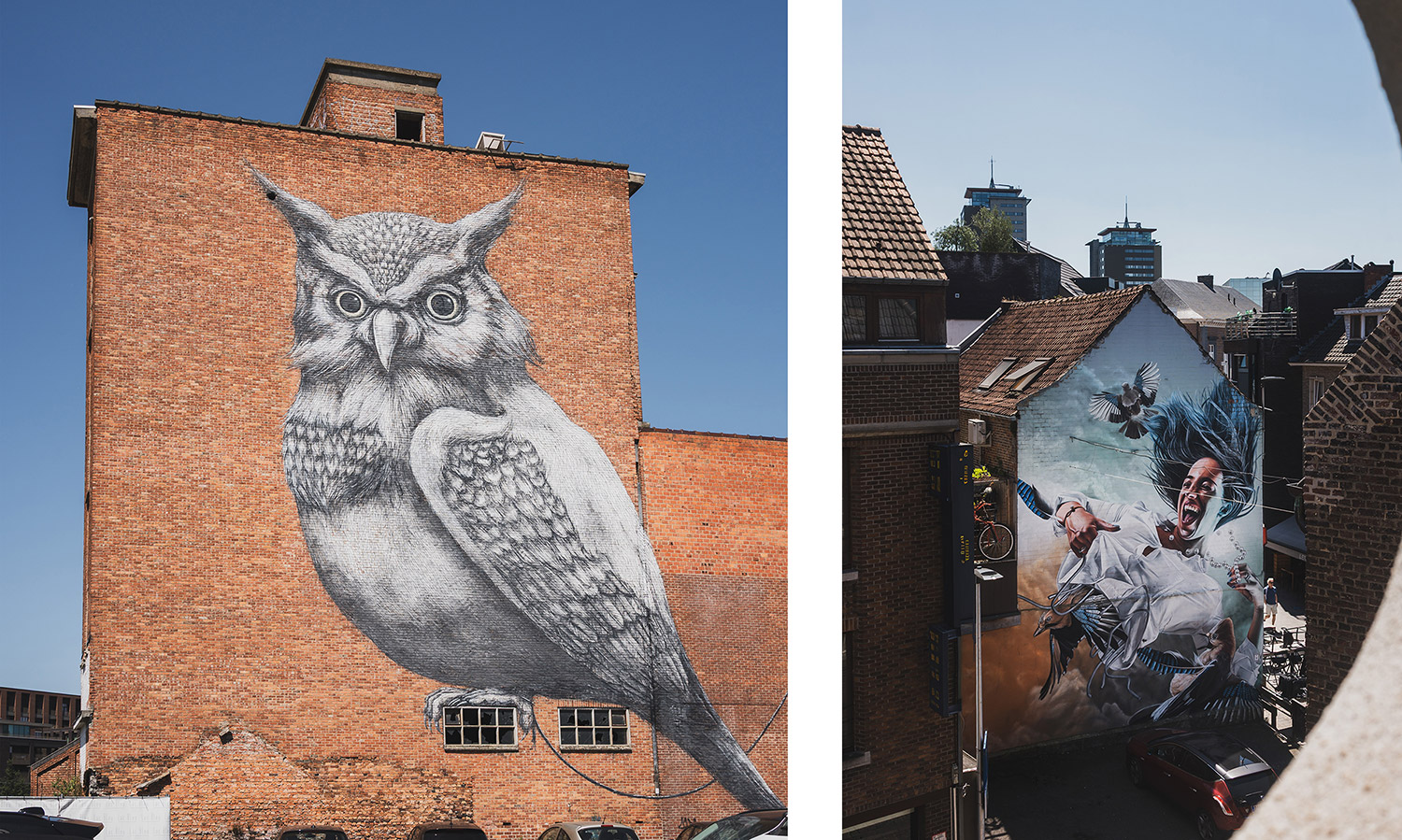
Some of the murals we came across while walking around Hasselt
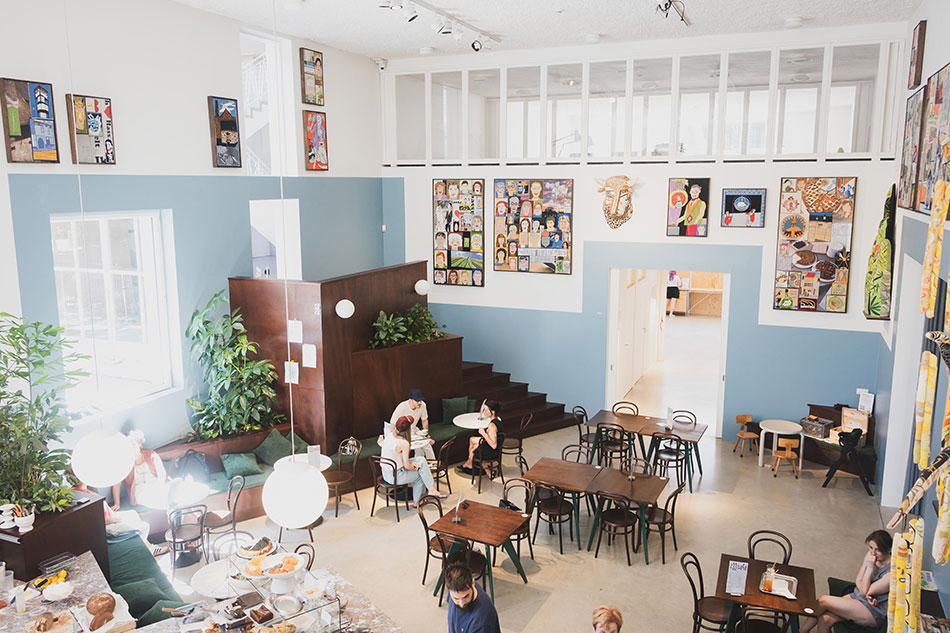
Z33 Café, Hasselt
Our first bike ride takes us to Herkenrode Abbey. The former convent, whose origins date back to the 12th century, now comprises an extensive complex of buildings and gardens that are well worth exploring at a leisurely pace. Among them is a recent installation by Gijs Van Vaerenbergh, the duo formed by Pieterjan Gijs and Arnout Van Vaerenbergh. Their names will reappear towards the end of our journey, when we encounter another of their works; for us, the two installations are among the most spectacular sights of the trip. It is our first example of the way historical heritage, contemporary art and landscape coexist quite naturally in Limburg. There is also a lovely terrace in the abbey gardens, perfect for a first stop before getting back on your bike.
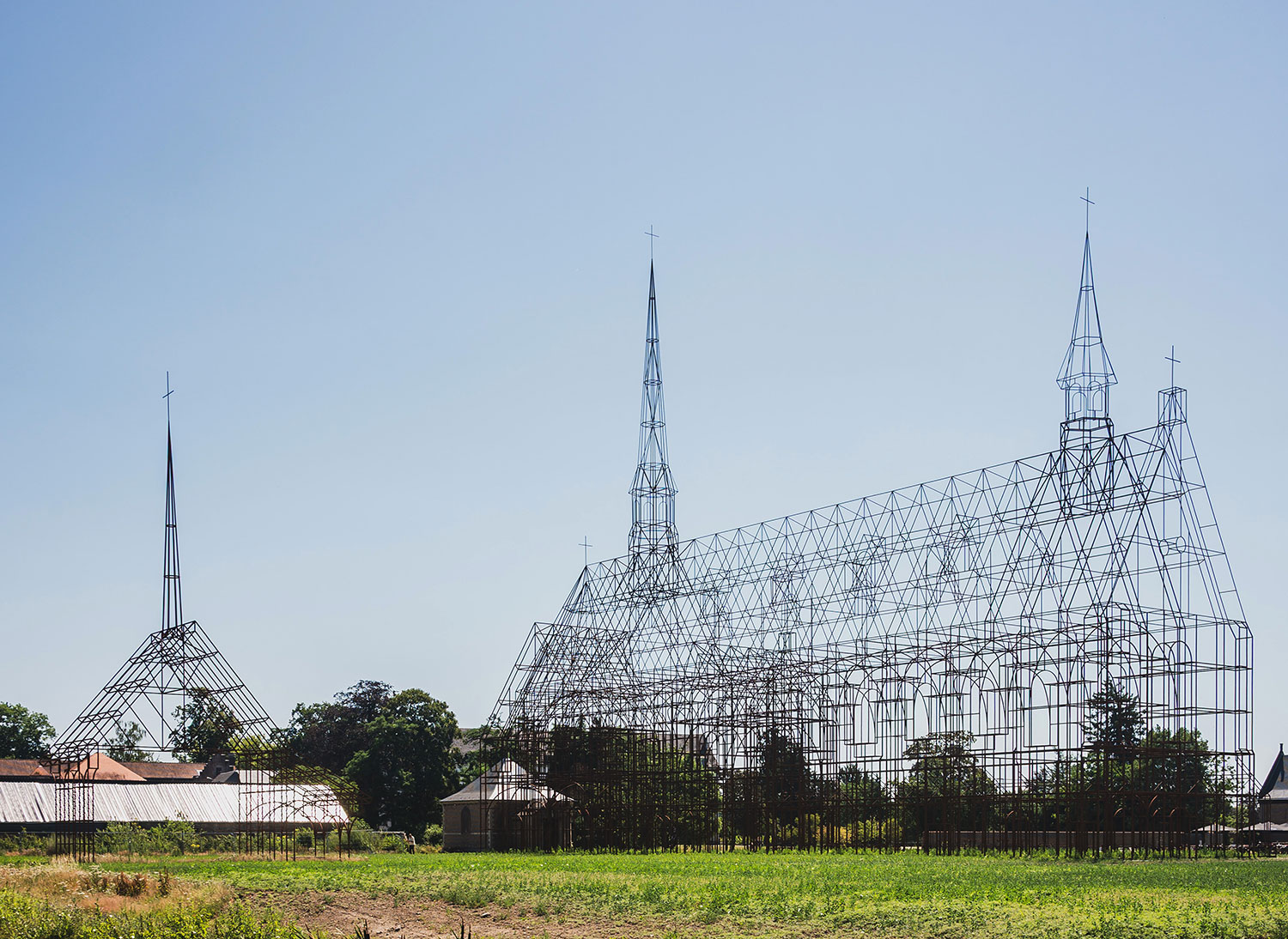
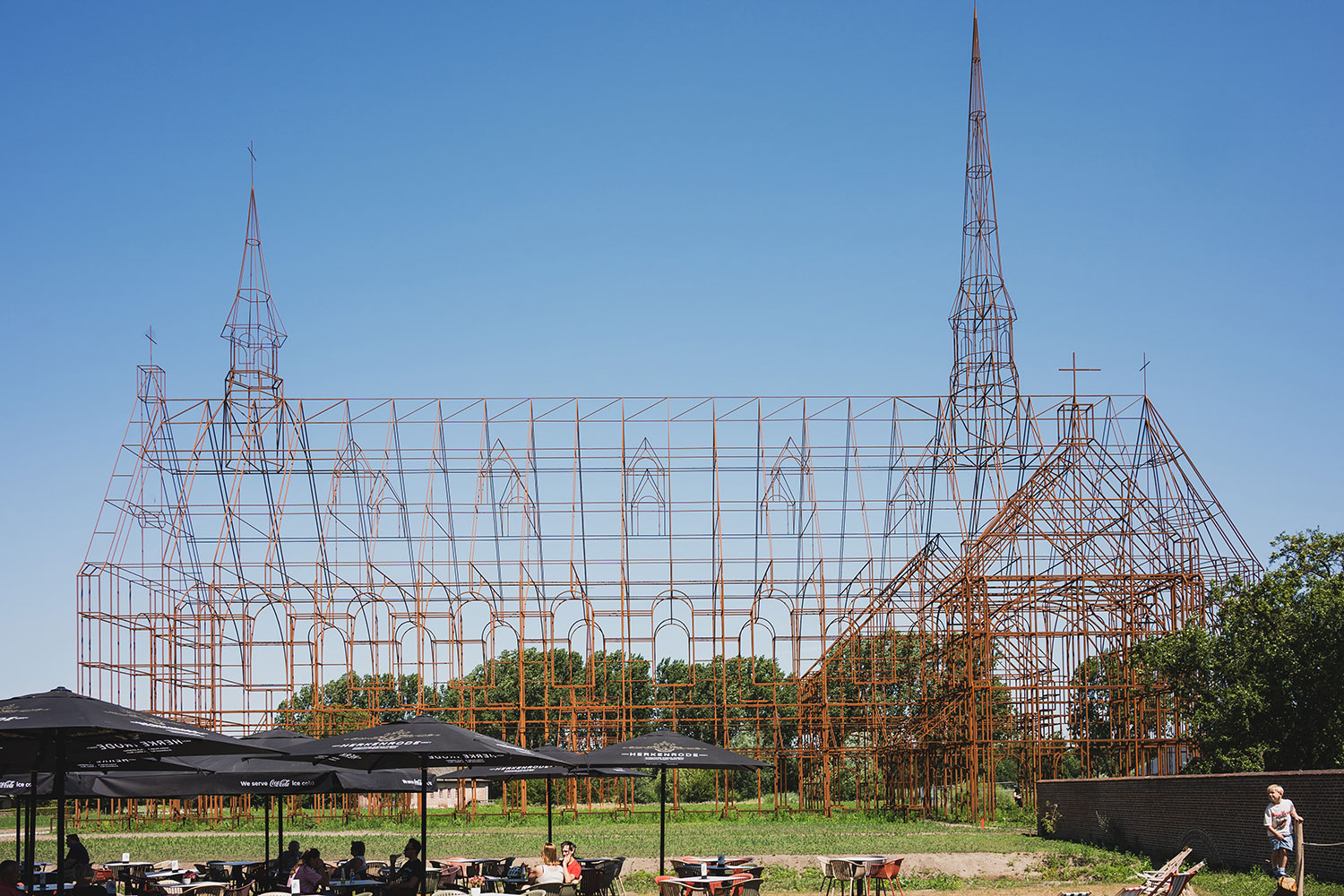
Two views of Gijs Van Vaerenbergh’s installation in the grounds of Herkenrode Abbey, on the outskirts of Hasselt
Back in Hasselt, and before leaving the city behind for good, the route takes us to another of its most distinctive places: the Japanese Garden, considered the largest in Europe. Covering almost two and a half hectares, it brings together ponds, waterfalls, bridges, rocks and pavilions inspired by the Japanese landscape tradition, and grew out of the ties Hasselt has maintained for decades with the city of Itami. The time of year can make a considerable difference to the experience. In spring, cherry blossom fills the garden with colour and is celebrated with hanami, while in autumn the maples transform the landscape with their intense reds and ochres.
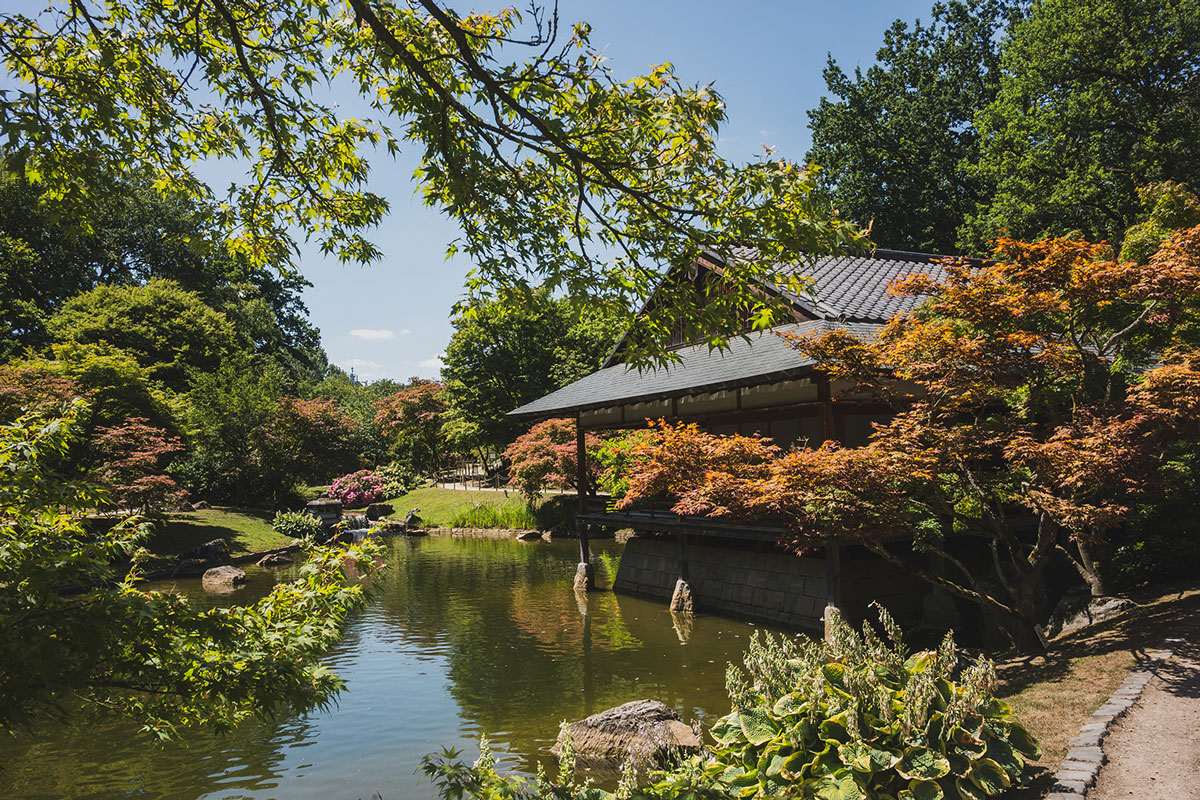
Japanese Garden, Hasselt
From here, we leave the urban surroundings behind and continue towards De Wijers, a vast area of ponds, woods and wetlands where water begins to shape the route. There, one of Limburg’s best-known cycling experiences awaits us: Cycling Through Water. The cycle path runs for about two hundred metres through a pond, bringing us almost level with the surface of the water. The effect is simple but striking, allowing us to cycle for a few minutes with water on either side and our eyes almost at the same level.
Beyond the inevitable photographs, Cycling Through Water also offers a first glimpse of something we’ll encounter time and again over the next few days: in Limburg, cycling infrastructure isn’t simply designed to make getting around easier; it is often conceived as a way of changing how you experience the landscape. It really is a paradise for cyclists.
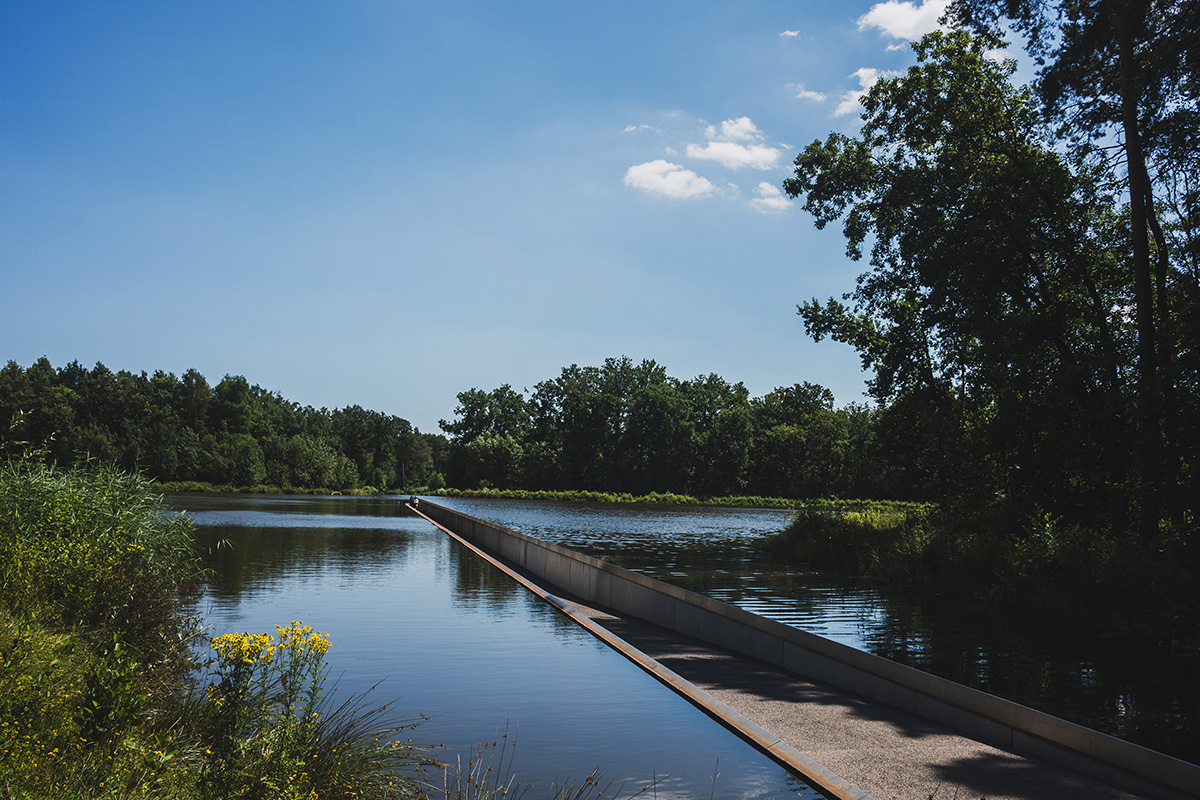
Cycling Through Water, an unforgettable experience in Limburg
FROM THE PAINTERS OF GENK TO THE MINES
Genk introduces another of the stories that run through Limburg: the transformation of a rural area into one of Belgium’s major mining regions, and its subsequent regeneration following the closure of the mines.
Before coal came the painters. In the late 19th and early 20th centuries, the Kempen landscape attracted hundreds of artists and turned Genk into an important meeting place for landscape painters. The small Emile Van Doren Museum tells this story in what was once the home of the painter Emile Van Doren (1865–1949). It is estimated that more than 480 artists visited Genk before its industrialisation to paint its heathland, ponds and forests. The museum preserves that legacy while also bringing it into dialogue with contemporary artists who are once again turning their attention to the landscape of the region.
The arrival of mining changed everything. The discovery of coal in 1901 led to the opening of three large mines in Genk and, within a few decades, transformed what had been a small rural settlement into an industrial and multicultural city. In Winterslag, where the first coal from the Kempen basin was extracted in 1914, the mine remained in operation until 1988. Today, its two large headframes mark the entrance to C-mine, one of the finest examples of the regeneration of the region’s industrial heritage. Parts of the old buildings now house cultural and design spaces, an art school, cinemas and creative projects. Those wishing to delve deeper into its mining past can even explore old tunnels and climb one of the headframes as part of the C-mine Expedition.
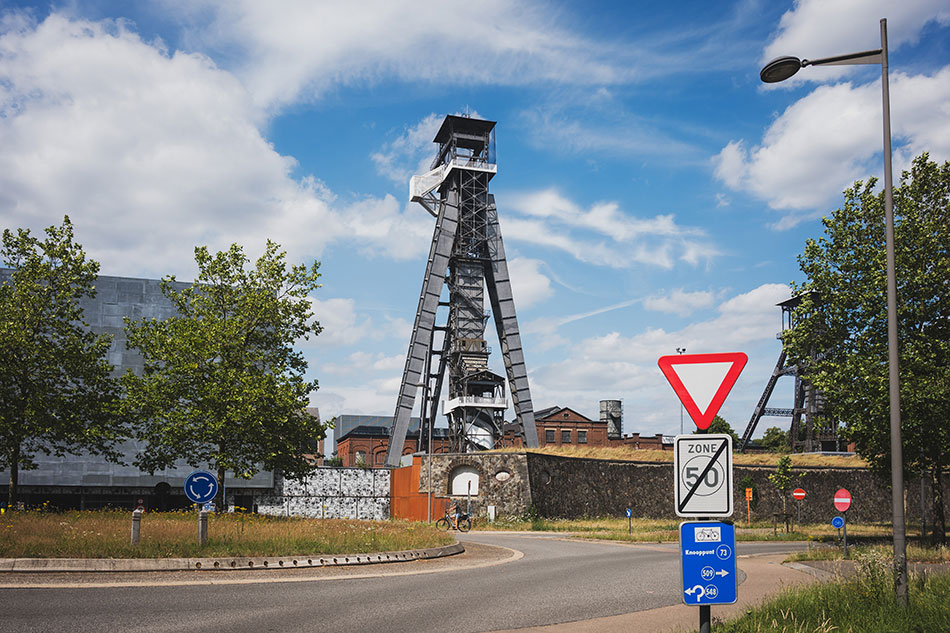
C-Mine, Genk
Nearby is LABIOMISTA, the personal project of Koen Vanmechelen, an artist born in Sint-Truiden and closely linked to Genk, whose work has explored questions of diversity, identity and the relationship between culture and nature for decades. The site is open to visitors and offers a good introduction to his distinctive vision and artistic practice. We’ll come across his work again a few kilometres further on, this time on the banks of the Meuse. Some of you, however, may already be familiar with his name. In 2025, he held his first solo exhibition in Spain, at Chillida Leku, and another in Madrid in late 2026.
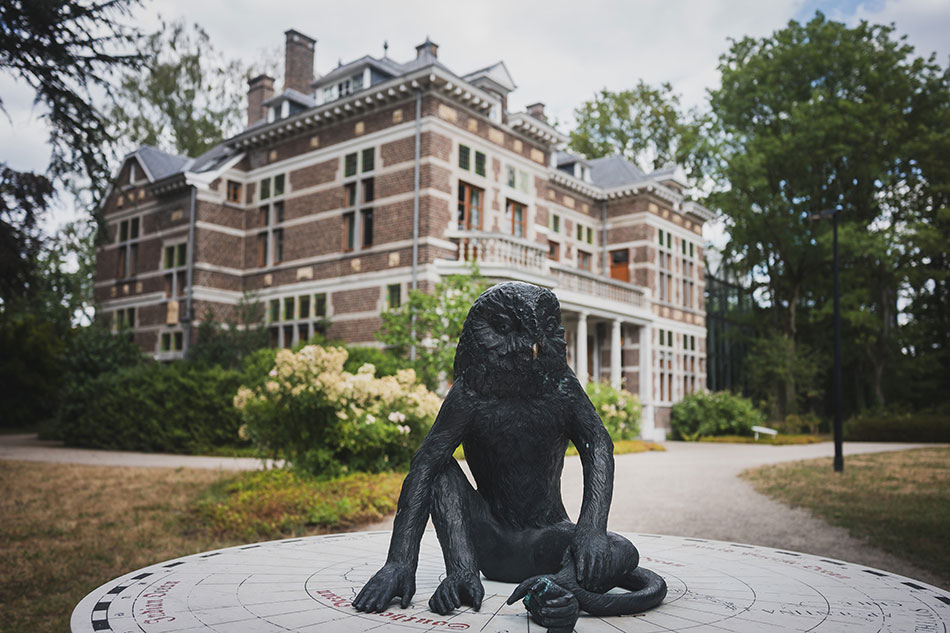
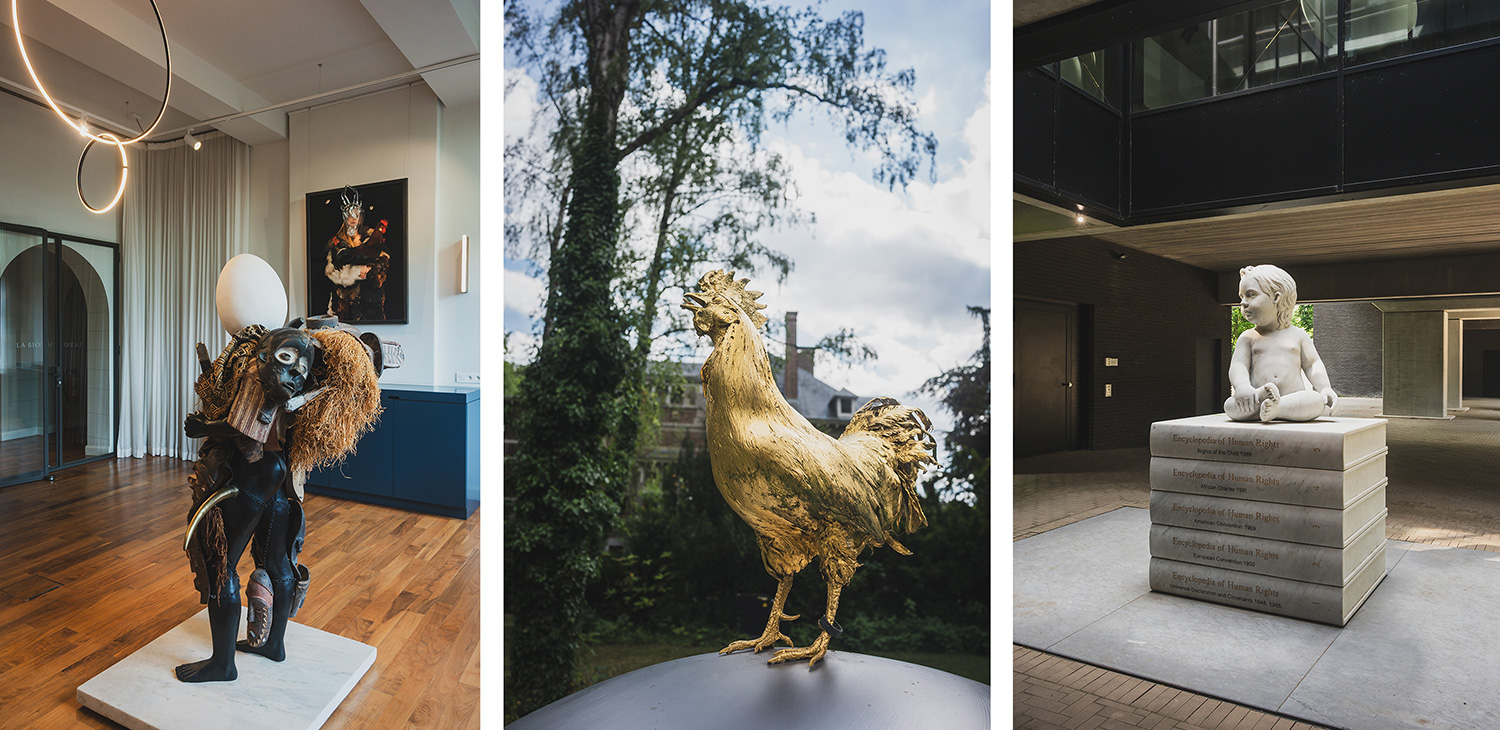
LABIOMISTA. Koen Vanmechelen’s studio and museum
We decided to end the day in As. We liked the way the route led us into the village and the lively atmosphere around its old station, now converted into a bar and restaurant and serving as one of the gateways to Hoge Kempen National Park. We stayed nearby at Mardaga, a simple but very pleasant hotel where we also had dinner, putting our bikes aside for the day.
FORESTS, WATER AND MINING HERITAGE
The next day, as soon as we set off, the forest completely transforms the landscape. Hoge Kempen was Flanders’ first national park, and its landscape of pine forests, heathland and former mining sites shows just how closely industrial history and nature have become intertwined in Limburg. From As, you enter the park almost immediately.
Here, that remarkable cycling infrastructure comes into play again, making some stretches of the route particularly spectacular. On reaching Terhills, in Maasmechelen, we find the main gateway to Hoge Kempen National Park and its visitor centre, located near the former Eisden mine. It is a good place to understand the profound transformation of this landscape. Where a coal mine operated until the late 1980s, there are now lakes and woodlands, while the former spoil heaps have become hills covered in vegetation. Some offer sweeping views over the park and the Meuse Valley.
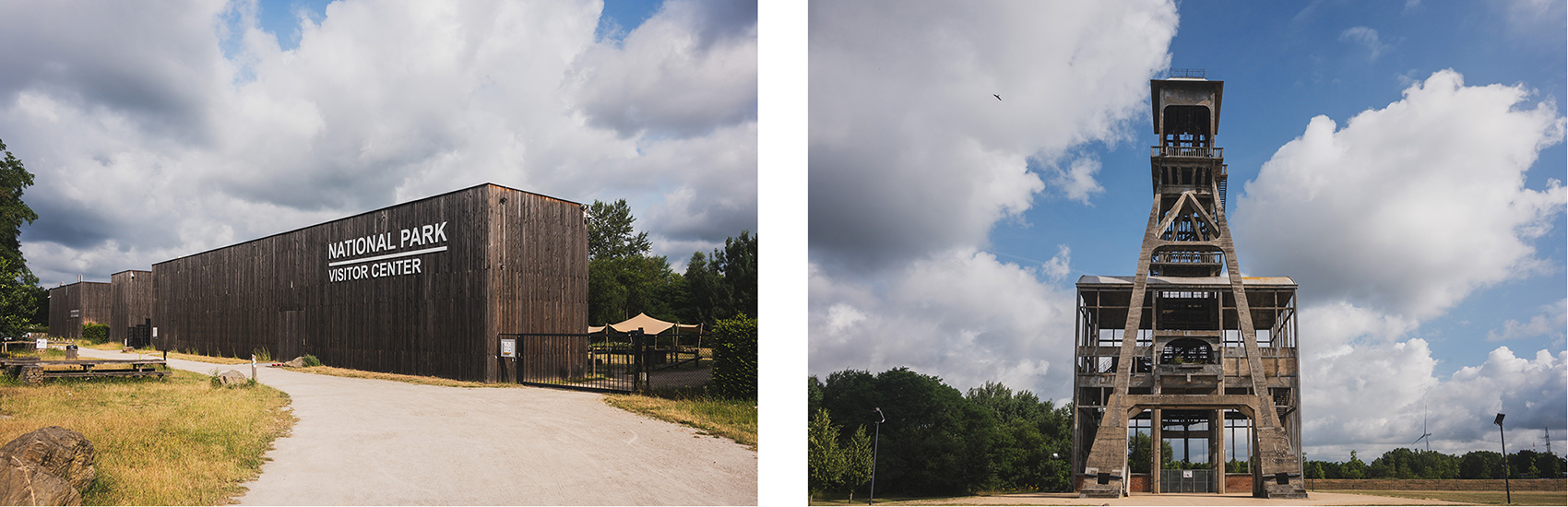
Entrance to Hoge Kempen National Park
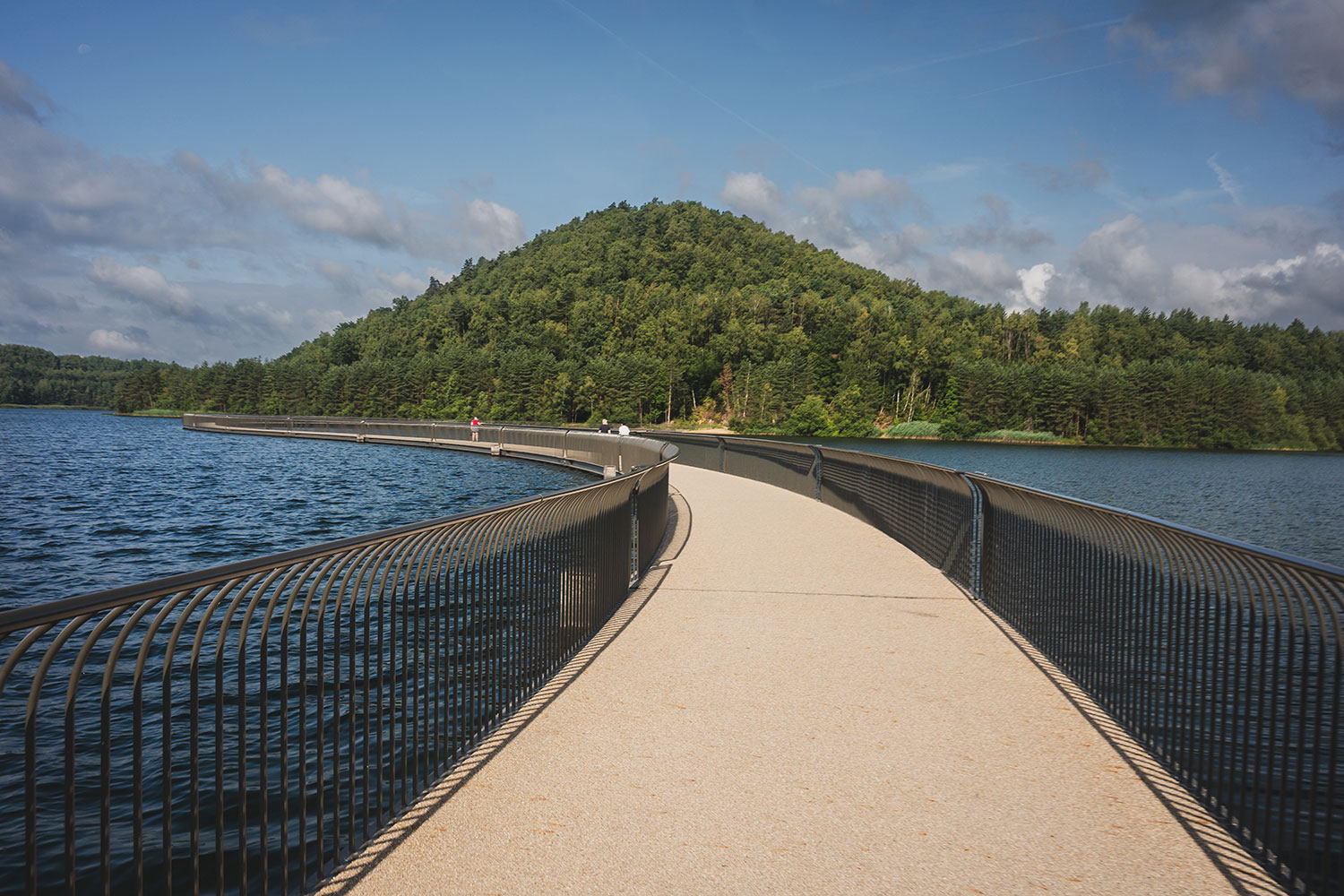
Cycling between Terrils. Hoge Kempen National Park
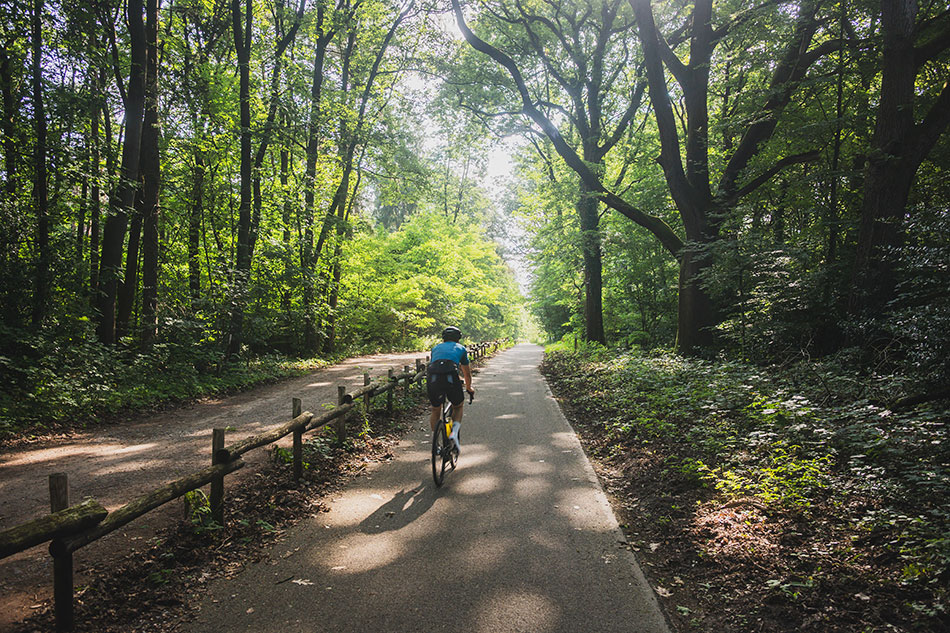
Hoge Kempen Nature Reserve, Limburg
After a brief stop, we continue on to try one of the most recent additions to this extraordinary cycling network: Cycling between Terrils. A 380-metre footbridge runs across the water between two former spoil heaps, allowing us to cross a landscape that, just a few decades ago, would have been difficult to imagine as a nature reserve.
Those wishing to gain some altitude can take a detour, but our route continues towards Dilsen. Small villages, castles and the remains of fortifications begin to appear and, little by little, the forest opens up. It is one of the most striking changes of landscape on the entire journey. We leave the dense woodland of Hoge Kempen behind and approach the Meuse, where fields, orchards and the first stretches of vineyards begin to appear.
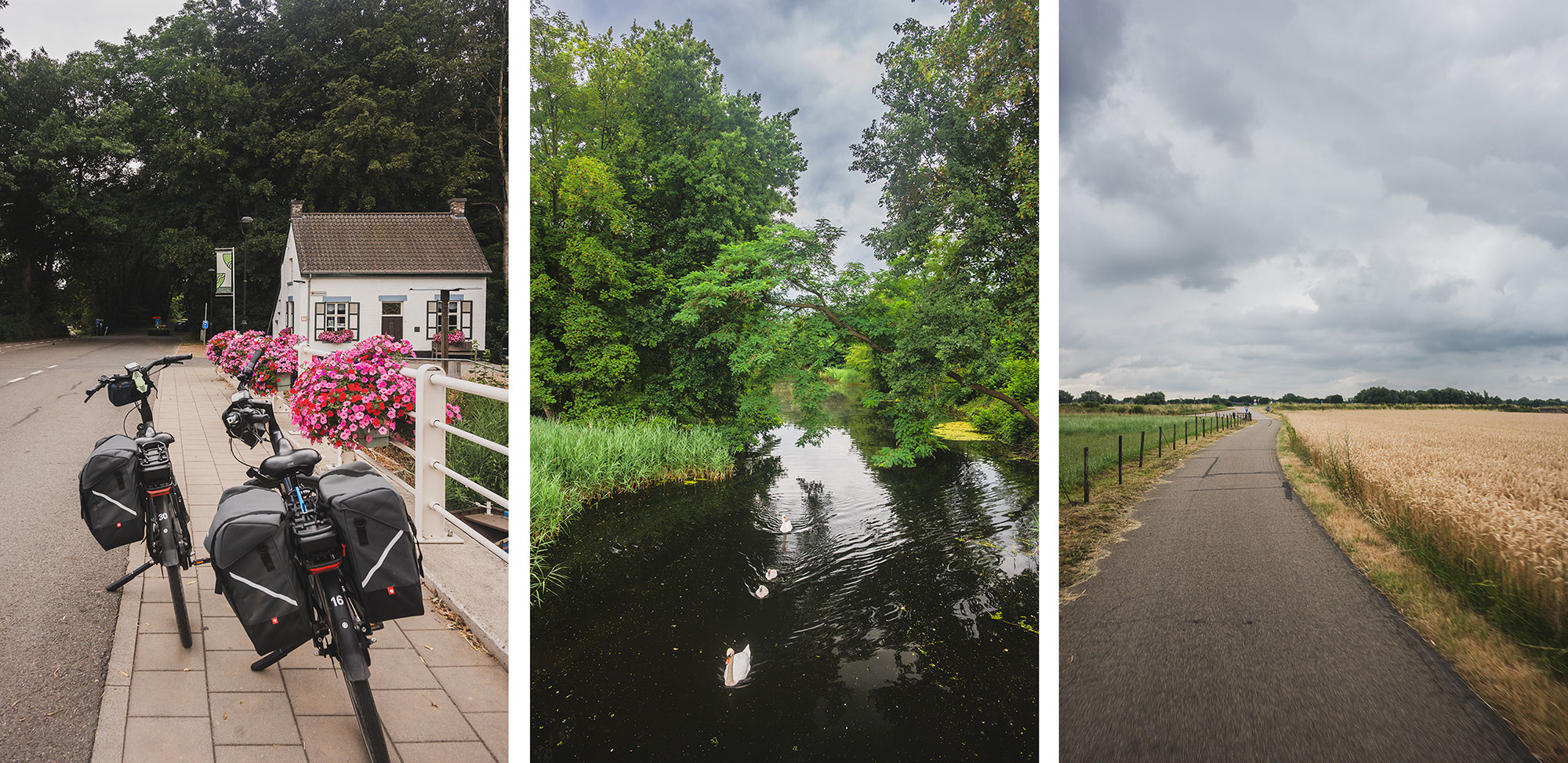
In the vicinity of Dilsen-Stokkem
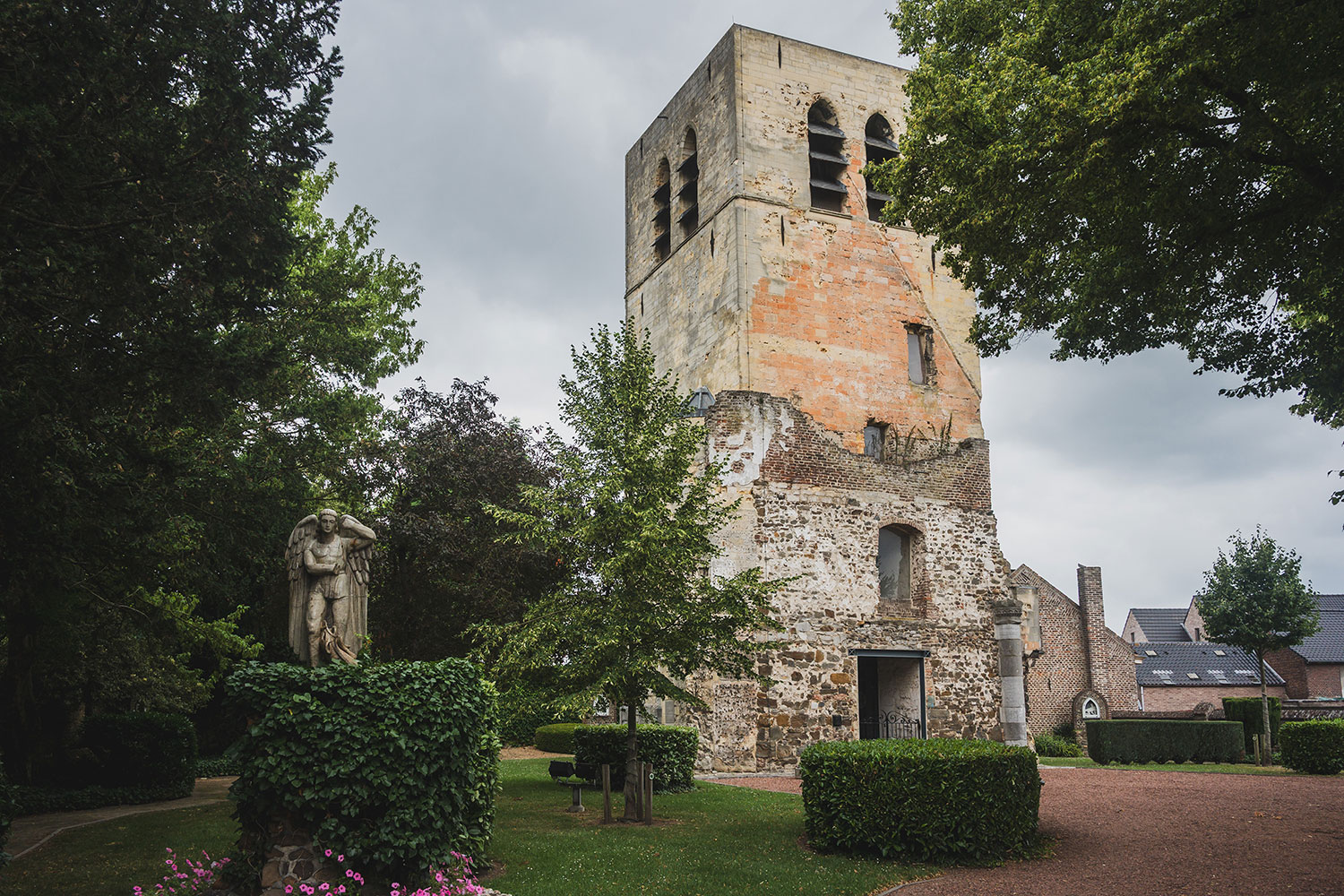
Mariapark. Oude Toren, Dilsen
AND WE COME ACROSS CONTEMPORARY ART
Along the river, we begin to encounter Kunst aan de Maas, a project through which Z33 and Regionaal Landschap Kempen en Maasland have gradually created a distinctive contemporary art trail through the Meuse Valley. The programme currently comprises six permanent installations spread across Dilsen-Stokkem, Kinrooi, Lanaken, Maaseik and Maasmechelen, all conceived in response to the landscape, history or transformations of a river that here serves as a border, a natural space and a fundamental part of the lives of its inhabitants.
The first work we encounter is Future Fossil, by the aforementioned Koen Vanmechelen, installed in Rotem, Dilsen-Stokkem. The sculpture brings together materials and elements closely connected to its surroundings, including old sandbags used to protect against flooding, a charred willow tree, beaver tracks and, high above, one of the recurring motifs in the artist’s work: the egg. Rather than an object simply placed in the landscape, it seems to have been constructed from its very tensions: water and earth, protection and threat, transformation and survival.
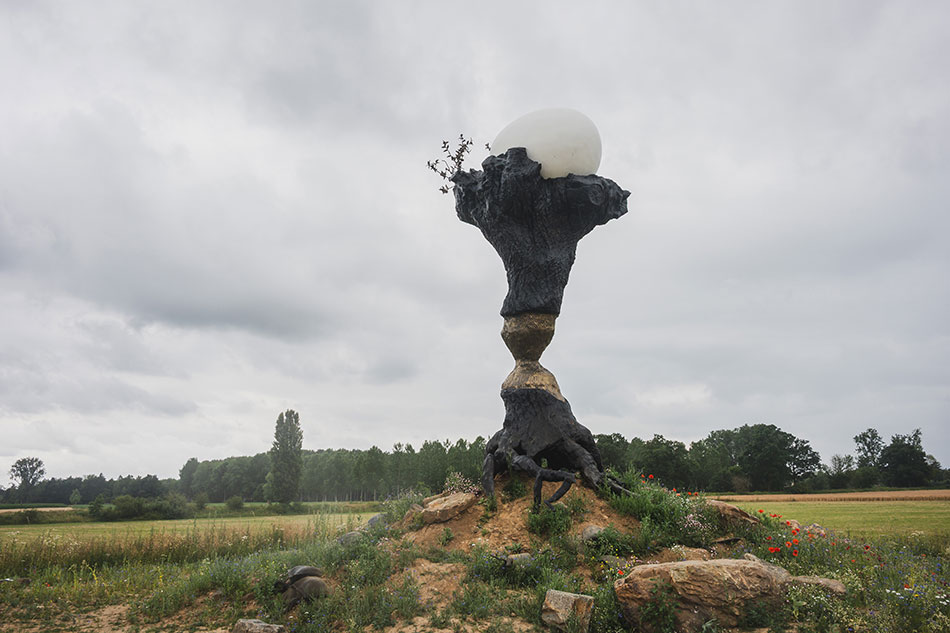
Future Fossil. Koen Vanmechelen. Art on the Meuse, Limburg
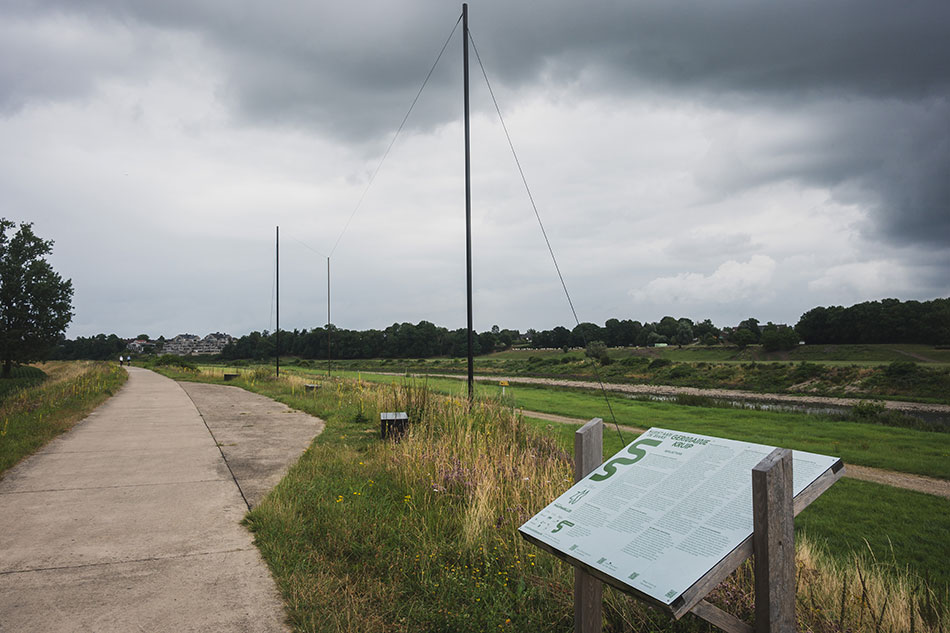
Reflection. Germaine Kruip. Art on the Meuse, Limburg
A little further on is Reflection, by Germaine Kruip, which recalls the old ferries that connected the two banks and would come in response to the sound of a bell, now reinterpreted by the artist.
This outdoor sculpture project extends beyond our original itinerary. In Kinrooi, Laure Prouvost has imagined Moeder! Oui dream till the end, a monumental ‘Mother Meuse’, a bronze creature, part human and part aquatic, that embraces gravel extracted from the site itself and changes its relationship with the surroundings as the water level rises. In Maaseik, Adrien Tirtiaux’s Echoes of a Landscape comprises three large towers evoking lost religious architecture; and on the grounds of Vilain XIIII Castle in Maasmechelen, Jennifer Tee has created Womb of Time, a 24-by-31-metre installation built from bricks made with clay from the valley and bearing imprints of leaves from trees on the estate. Unveiled in June 2026, it was the latest work to join the project.
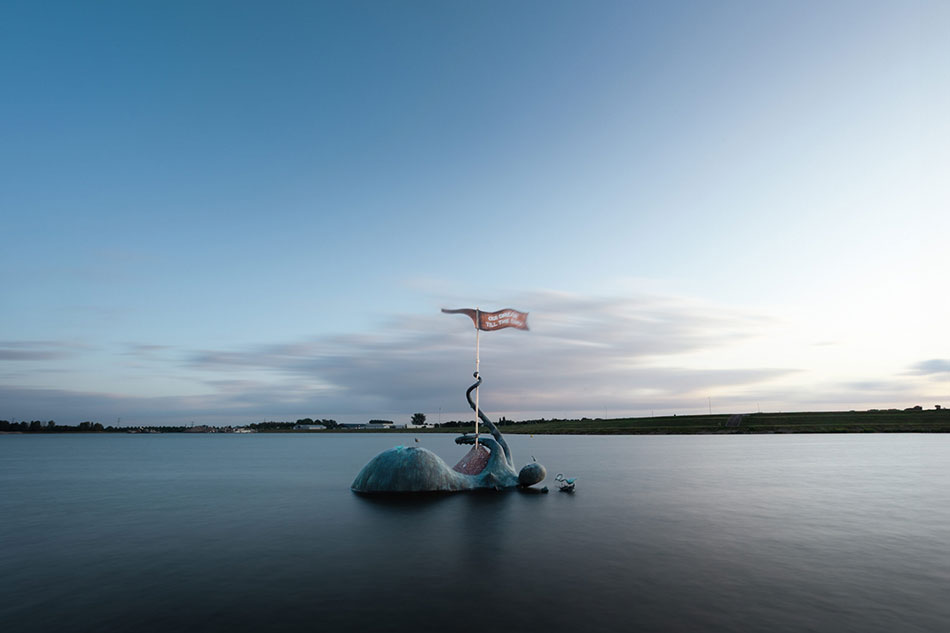
Laure Prouvost. Moeder! Oui dream till the end. Art on the Meuse, Limburg. Photo: kunstenademaas.be
In Maaseik there is an added connection for anyone interested in Flemish painting. Tradition holds that Jan and Hubert van Eyck were born here, although there is no conclusive documentary evidence. A statue of the brothers has stood in the Markt since 1864, a reminder that the history of the great Flemish masters extends far beyond the cities where most of their works can be found today.
We continue towards Oud-Rekem. Before entering the village, it is well worth stopping at the old St Peter’s Church, now a museum. Its history goes back to an initial chapel built in the 10th century and has been marked by successive periods of destruction and reconstruction. It is also part of another artistic map that accompanies us on our journey: Flemish Masters in Situ, an invitation to seek out specific works in churches, chapels and historic buildings, preserving the connection between the artwork and the place in which it acquired its meaning.
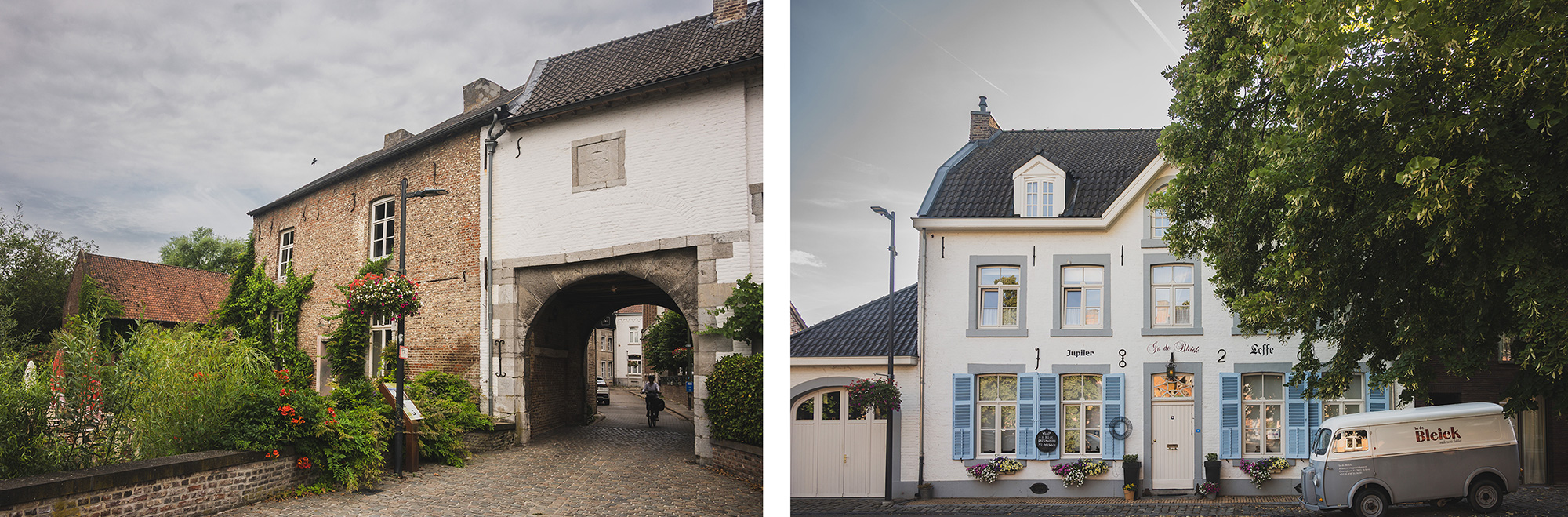
Oud-Rekem
Oud-Rekem is well worth parking the bikes for a while. Aspremont-Lynden Castle, the old town gate, the historic chemist’s and its narrow streets all recall the remarkable past of this small village in the Meuse Valley. A motte-and-bailey fortification stood on the site of the present castle as early as the 10th century, although the building we see today is largely the result of the major transformation undertaken by the Counts of Rekem in the 16th and 17th centuries to turn it into their residence. Its later history was considerably more eventful. Following the French occupation, it ceased to be a noble residence and went on to serve as a military hospital, a care home and a psychiatric institution. Today it is protected as a listed building and, although its interiors are not regularly open to visitors, it occasionally opens its doors for exhibitions and other events.
It was not an isolated castle. For centuries, Rekem was a tiny independent territory within the Holy Roman Empire, with its own administration and courts, the right to levy tolls and mint coins, and even a small army. It is hard to imagine all that political activity while strolling through its quiet streets today. The historic centre, protected in its entirety, was voted the most beautiful village in Flanders in 2008.
Its proximity to Maastricht — just 10 kilometres away — also makes Oud-Rekem an easy excursion for those of you who often travel to the Dutch city for TEFAF. In no time at all, you can stroll through the historic centre, visit the Museumkerk and discover a place that feels surprisingly removed from the lively atmosphere of its famous neighbour.
We also had a wonderful experience at Pas de Choix, a small restaurant on Herenstraat that began as a project by two friends, Hans Leufkens and Guido Vissers, brought together by their love of cooking. The name — pas de choix, ‘no choice’ — sums up the concept with a certain sense of humour: rather than having to choose from a long menu, you simply opt for meat, fish or a vegetarian alternative and leave the rest to the chefs. A simple formula that worked wonderfully for us, and one of those enjoyable dinners that, after several hours of cycling, end up becoming part of what we remember about the trip.
TOWARDS TWO THOUSAND YEARS OF HISTORY
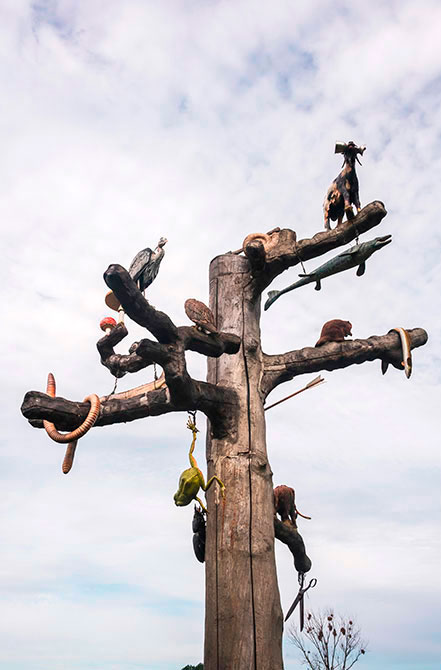
Tree of Life. Mark Dion. Art on the Meuse, Limburg
In the morning, we have barely left Oud-Rekem behind when Mark Dion’s Tree of Life comes into view, another of the permanent works in Kunst aan de Maas. The American artist conceived this six-metre-high tree populated by sixteen figures spanning millions of years of the valley’s natural and human history, from the mosasaur and the mammoth to the beaver and the heron that inhabit its banks today. It is a fitting farewell to the Meuse, as from here the journey changes once again.
On the way to Tongeren, we pass through Vroenhoven. Beneath its bridge, an exhibition space explores the Second World War and inland navigation. This is not an isolated reminder of that history: numerous defensive structures survive in the area, including anti-tank bunkers, recalling Limburg’s strategic role during the conflict. It is surprising to come across them along the way.
Then come castles, small chapels and vineyards. Château Neercanne, right on the Dutch border, overlooks the Jeker Valley from a hillside. This 17th-century Baroque castle now houses a small five-star hotel with seven suites, as well as a Michelin-starred restaurant; an option worth considering for those wishing to include a gastronomic stop — or a slightly more luxurious overnight stay — on their itinerary. A little further on, the small Chapel of Saint Apollonia is striking for its circular plan. It was not originally built as a religious building, but as a watchtower, before being converted into a chapel in the 18th century. And Genoels-Elderen Wine Castle offers an excellent excuse to discover for yourself that wine has also found an important place in this part of Limburg.
Before reaching Tongeren, the Church of St Stephen in ’s Herenelderen is well worth another detour. The Gothic building houses a 16th-century Antwerp altarpiece on its high altar, with scenes from the life of Christ and the Old Testament, as well as historic tombstones belonging to local nobility. It is one of those visits that captures the essence of Flemish Masters in Situ. A work that would probably go unnoticed on a conventional itinerary takes on a different dimension when encountered in the church for which it was originally intended.
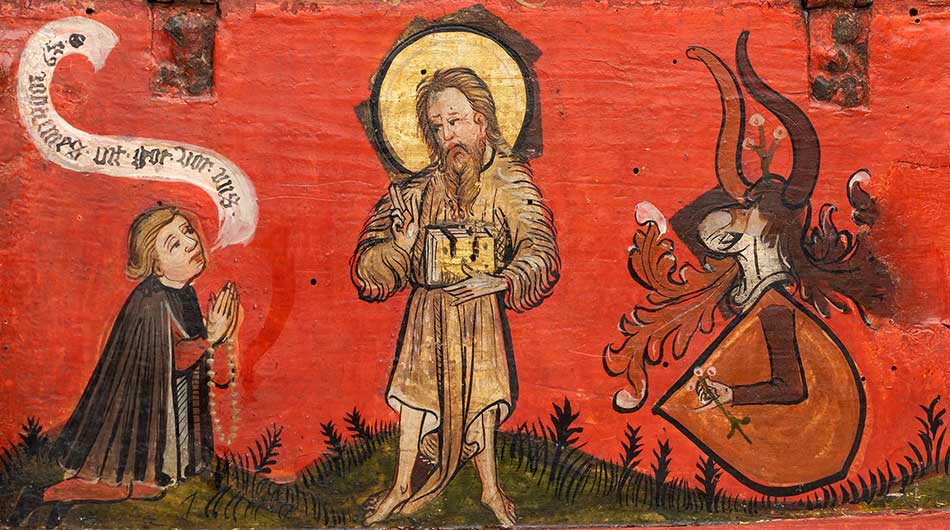
Reliquary at St Stephen’s Church in ’s Herenelderen (detail from one of its paintings). Image: Jan Bellen – Jeroen Reyniers – Office for Historical and Artistic Research. Flemishmastersinsitu.com
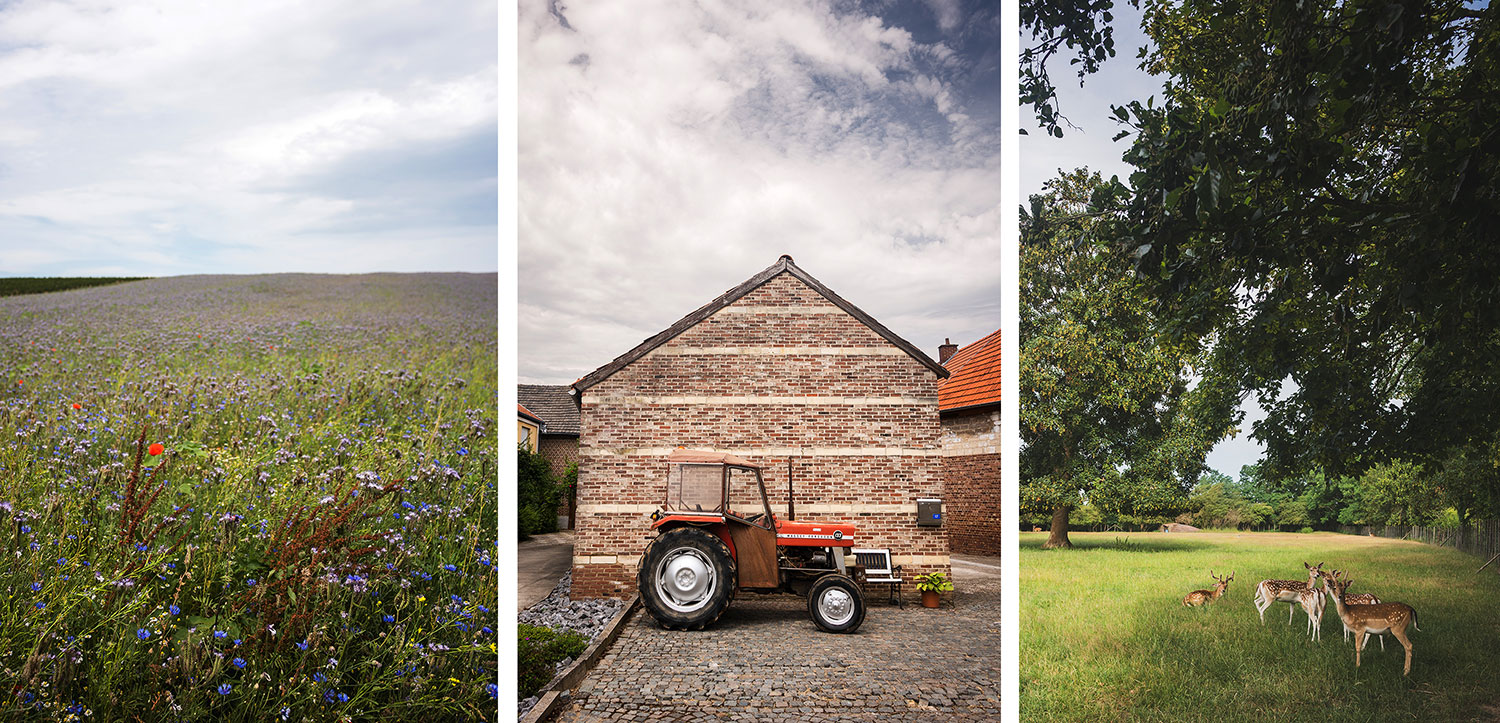
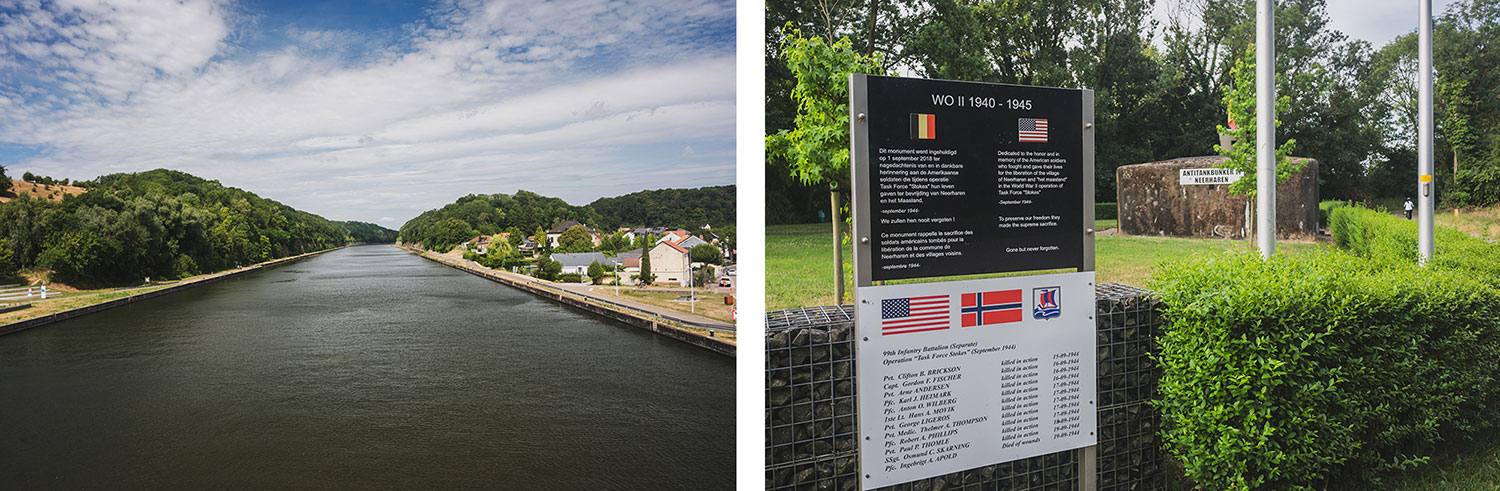
Some stops along the way
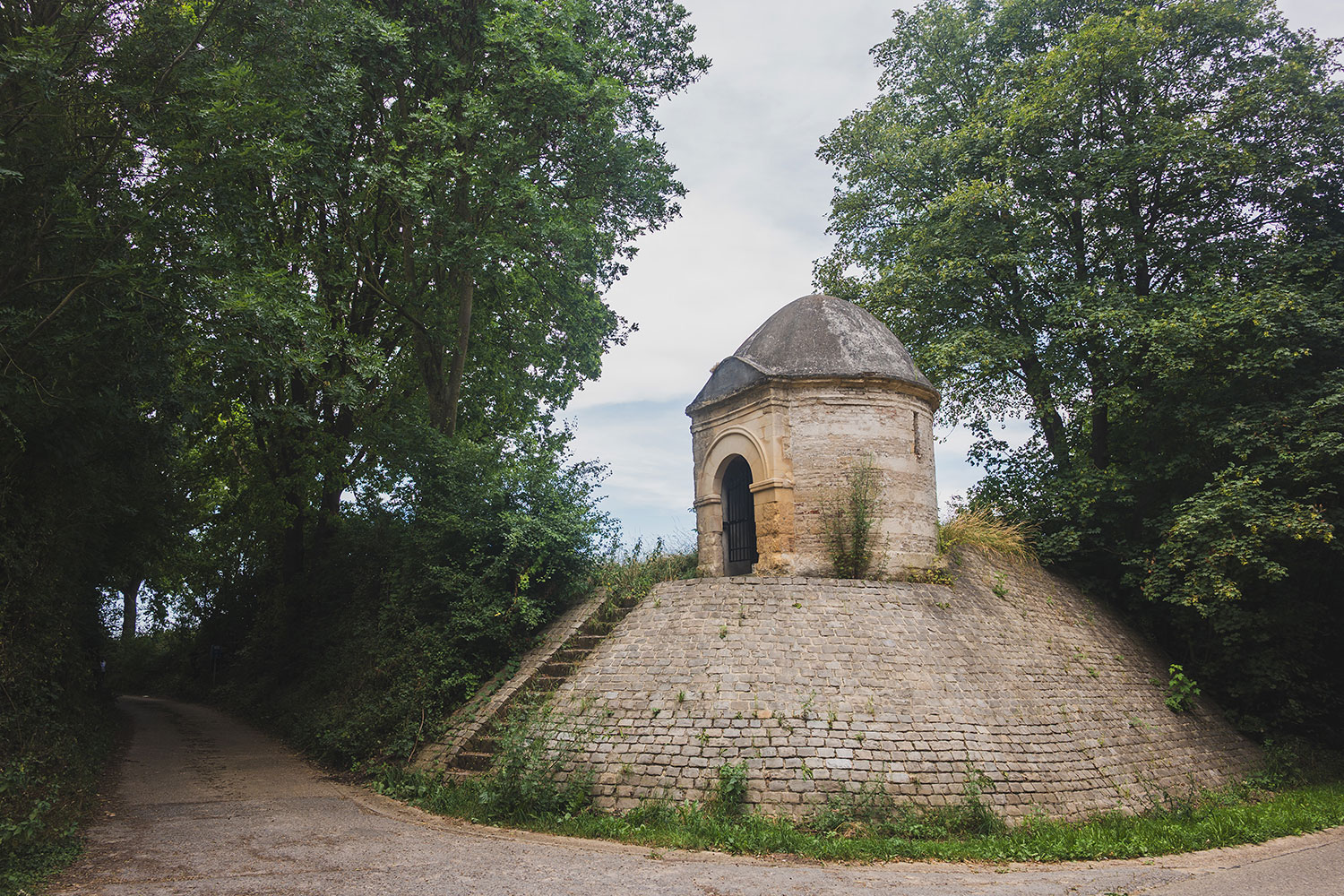
Chapel of Saint Apollonia, Riemst
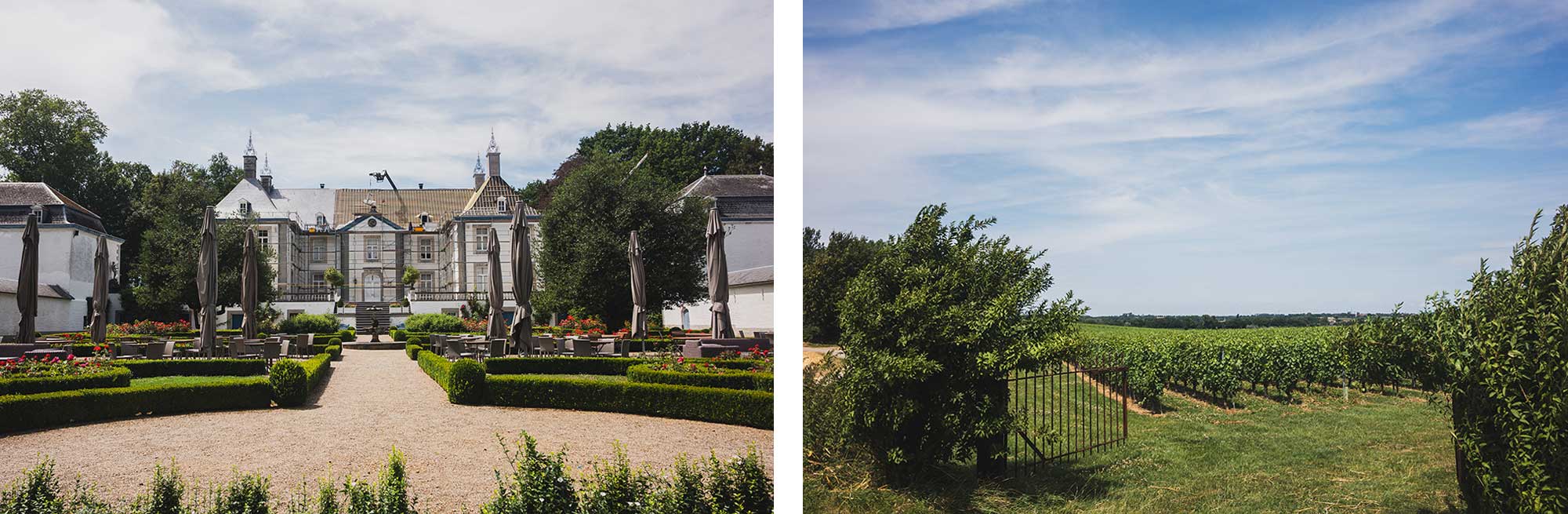
Genoels-Elderen Wine Castle, Riemst
WE ARRIVE IN TONGEREN
Today’s Tongeren-Borgloon is rightly proud of its Roman origins. The Gallo-Roman Museum traces the archaeological history of the region from prehistoric times and was named European Museum of the Year in 2011. The city is also well worth exploring on foot, taking in the remains of its Roman and medieval walls, the Moerenpoort — one of its old fortified gateways — and the striking statue of Ambiorix, one of Belgium’s earliest heroes. Created in 1866 by the sculptor Jules Bertin, it dominates the square, commemorating the chieftain of the Eburones who fought against Caesar’s legions.
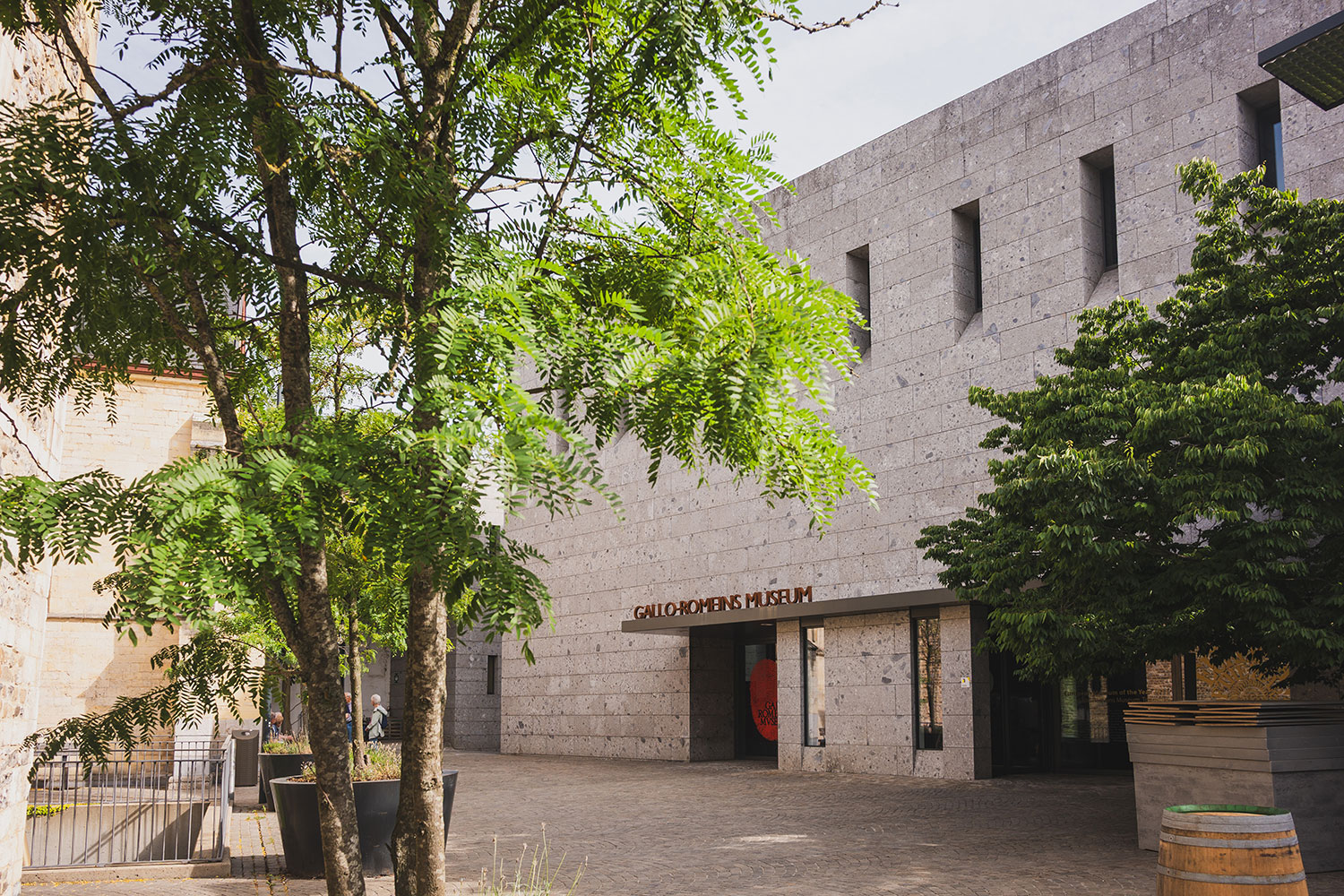
Gallo-Roman Museum, Tongeren
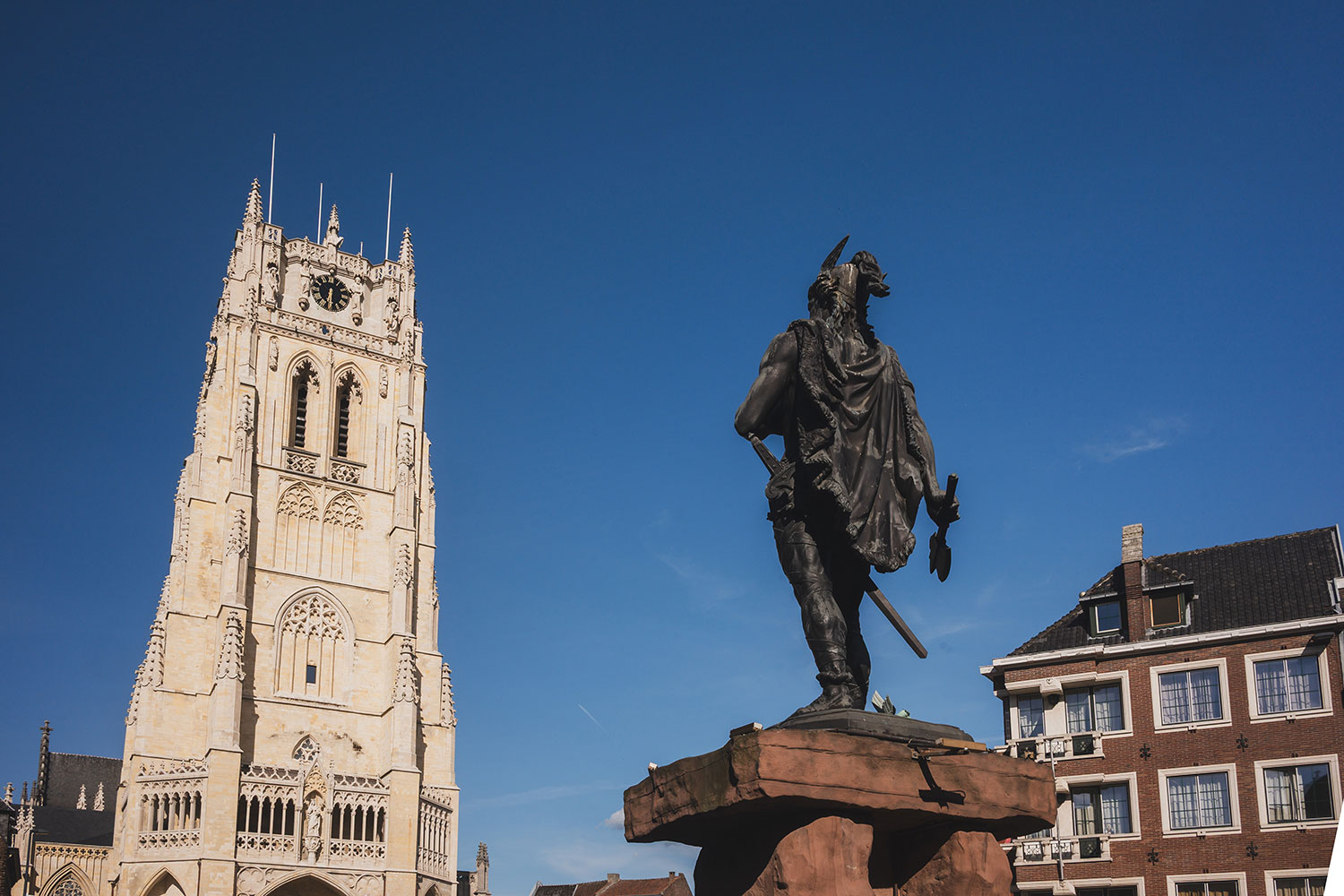
Our Lady’s Tower and the statue of Ambiorix, on the Grote Markt in Tongeren
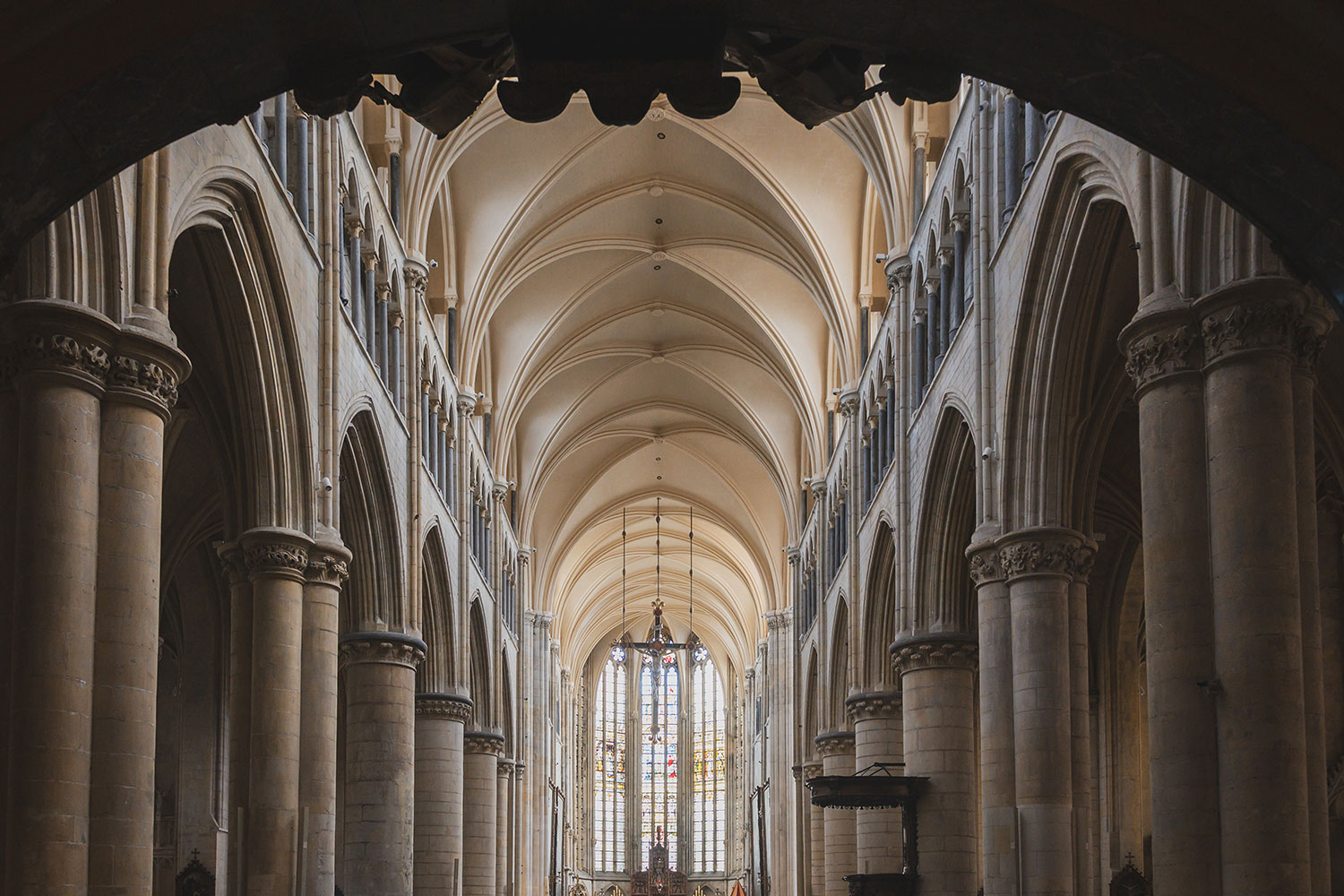
Central nave of the Church of Our Lady, Tongeren
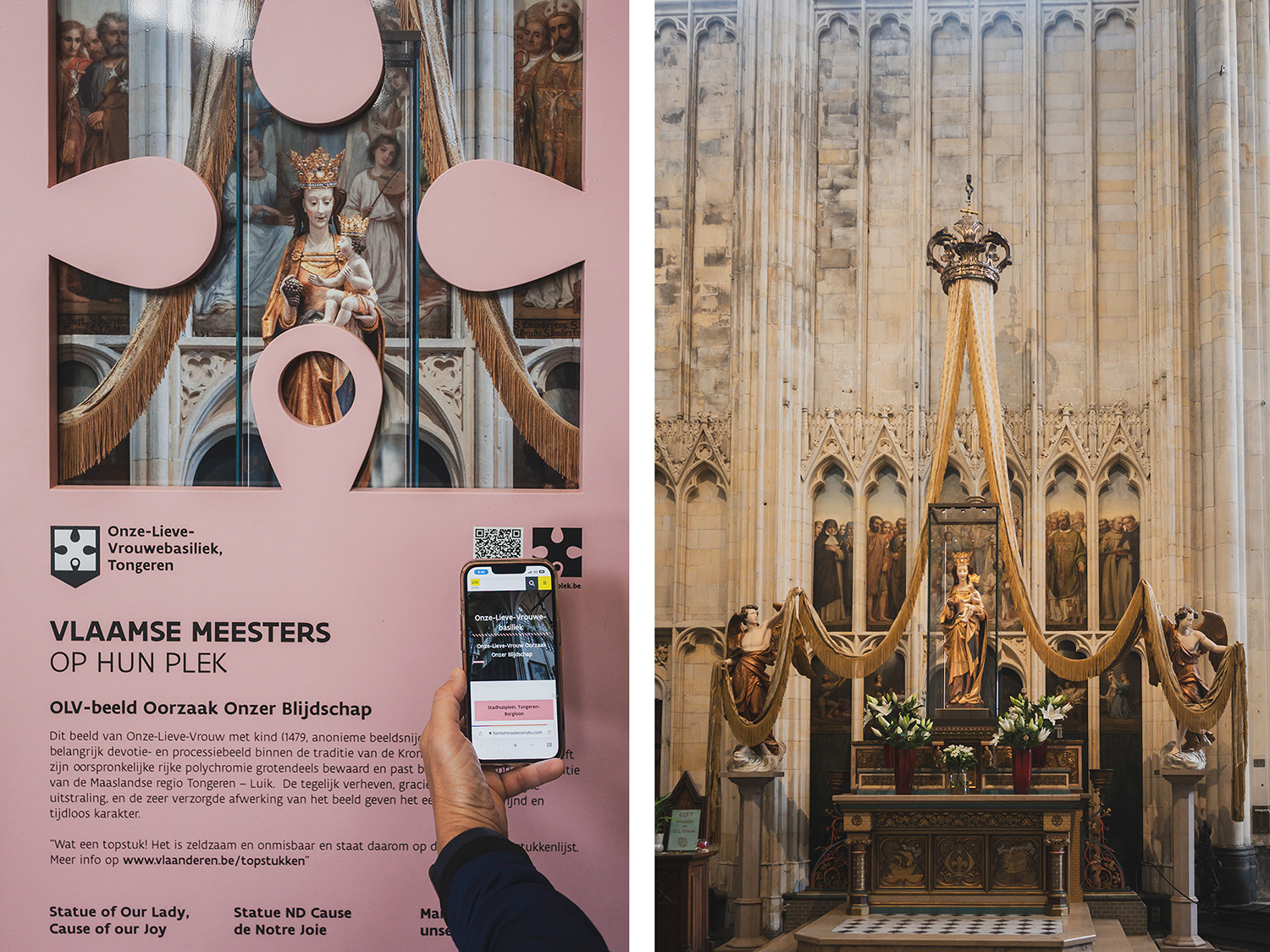
Flemish Masters in Situ. Our Lady and Child (1497), Cause of Our Joy. Church of Our Lady in Tongeren
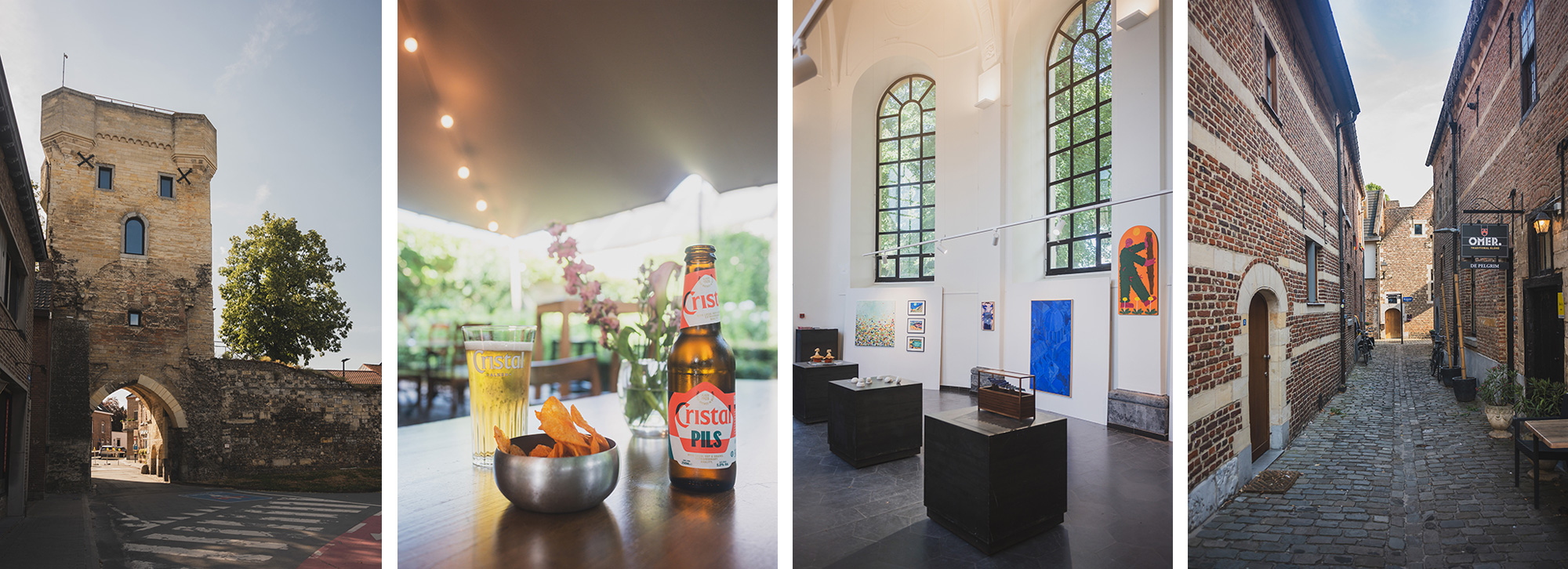
Moerenpoort, the only medieval gateway still intact in Tongeren; aperitif, exhibition and narrow lane in the Beguinage of St Catherine, Tongeren
One of the city’s great religious landmarks is the Basilica of Our Lady. Its treasury, the Teseum, houses objects spanning centuries of ecclesiastical history, while the archaeological trail takes visitors beneath the complex to discover the successive structures that occupied this site over almost two thousand years.
Nearby is the old beguinage, also well worth a visit. It is worth remembering that beguinages were communities of women who, without necessarily taking monastic vows, developed a form of religious and independent life from the Middle Ages onwards that became particularly widespread in the former Low Countries. In Tongeren, the Begijnhofmuseum Beghina offers a glimpse of that everyday life on a domestic scale, far removed from the monumentality of the basilica.
After a day of cycling and exploring the city, it is time to rest, look back on everything we have seen and start thinking about the next day’s route, when we’ll set out in search of an image we’ve seen many times in photographs and will finally be able to experience in person. But let’s not get ahead of ourselves. We spend the night at Huys van Steyns, a small hotel housed in a stately home dating from 1892 that was once the residence of Louis Steyns, founder of the Ambiorix footwear company. We particularly liked it because it retains much of the domestic atmosphere of the original building — high ceilings, parquet floors, fireplaces… — and staying there feels a little like stepping, for a few hours, into one of those traditional houses we’ve been seeing along the way. Breakfast, served in the old orangery overlooking the garden, brings our stay in Tongeren to a pleasant close.
WHEN ART APPEARS AMONG THE FRUIT TREES
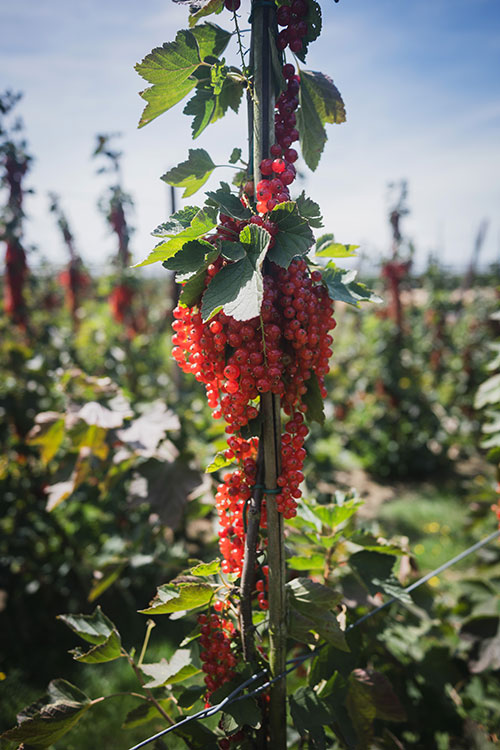 As we leave Tongeren, we can already sense the landscape changing once again. We enter Haspengouw, one of Belgium’s major fruit-growing regions. The forests and lakes of the north are now behind us, replaced by rolling hills, fields and apple, pear and cherry trees, dotted with churches, farms and small villages. Here, too, contemporary art has found its place in the landscape.
Along the way, we pass orchards and small roadside stalls where, depending on the season, you can buy a basket of freshly picked fruit directly from the growers — a particularly welcome snack during the ride. The importance of this agricultural tradition becomes even clearer in Borgloon, where we stop at the Stroopfabriek, a former factory dedicated to making stroop, the thick apple and pear syrup so characteristic of the region. Restored as a place where visitors can discover the history of fruit production in Haspengouw, the complex retains much of its industrial past and serves as a reminder that the fields we have been cycling through for hours have also sustained an entire local economy.
Many of the art installations we encounter in this area are linked to PIT, another Z33 project that has brought artworks into the public spaces of Borgloon and Heers. The result is not a sculpture park in the conventional sense. The works are kilometres apart and you have to seek them out — which is precisely what makes cycling the ideal way to explore them.
Near Mariënlof Abbey, in Kerniel, a circular structure by Aeneas Wilder, built from vertical wooden slats, frames the landscape in 360 degrees. Further on, Will Beckers’ Time Capsule draws our attention to another dimension of the landscape: the ground beneath our feet and its geological history.
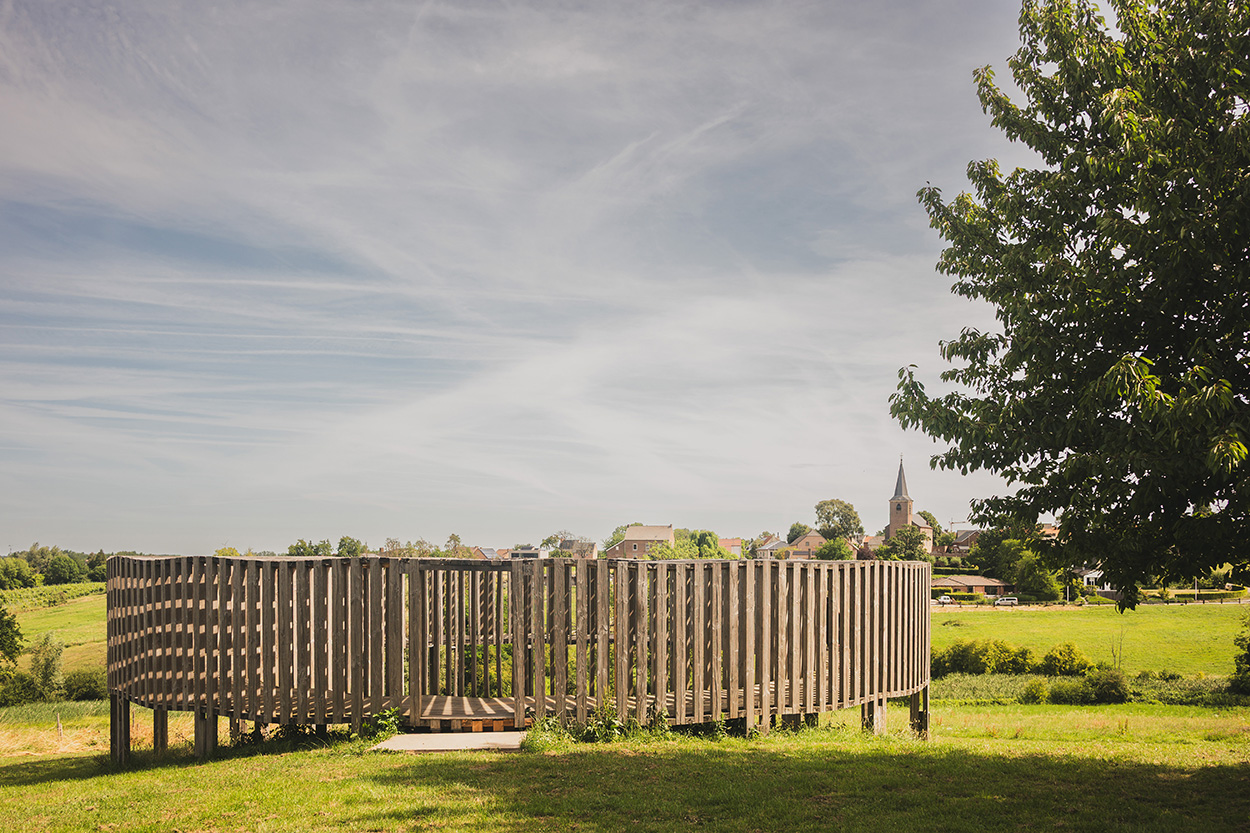
Aeneas Wilder. Untitled #158, Borgloon
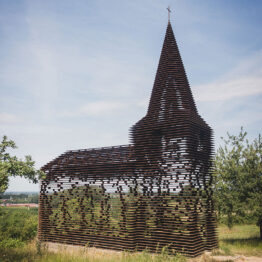
But the best-known and most eagerly awaited work lies ahead in Groot-Loon. Reading Between the Lines, by Gijs Van Vaerenbergh, recreates the silhouette of a small local church using a hundred horizontal layers of steel. We mentioned this artist duo at the start of our journey, but that wasn’t the first time their work had appeared on masdearte. We had already encountered their work when we visited Wandering Garden, their installation for the art and science trail created in Leuven to mark the 600th anniversary of its university.
The structure is ten metres high and weighs around thirty tonnes, yet it allows the landscape to pass literally through the building. Depending on where you stand, the church seems to take on a solid form or dissolve into the fields. We had seen it many times in photographs before travelling here and, even so, reaching it by bike makes the experience quite different. It does not stand apart like a sculptural object, but feels connected to the paths, the slopes and the agricultural landscape around it. It is hard to imagine it anywhere else.
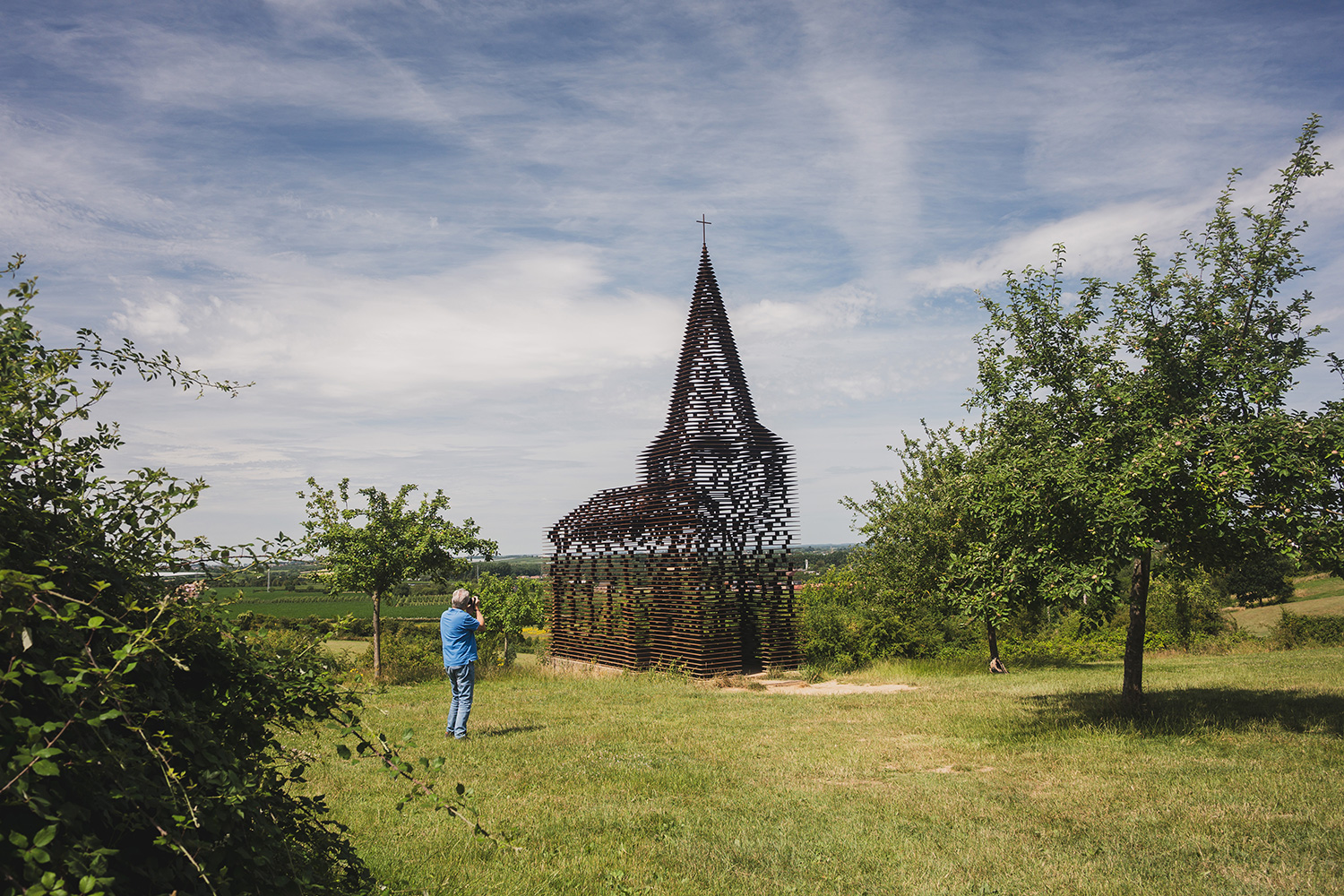
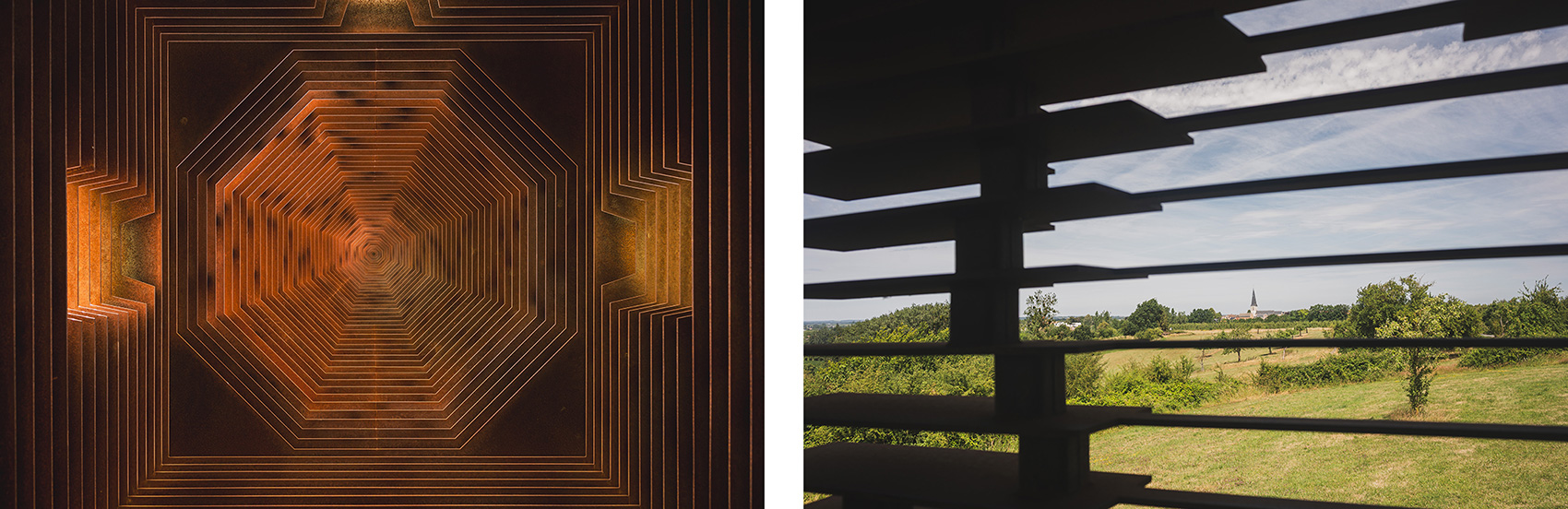
Gijs Van Vaerenbergh. Reading Between the Lines, Groot-Loon
The dialogue with history continues along the ancient Roman road that linked Tongeren and Tienen. There, Hans Lemmen installed five concrete benches whose outlines recall a Roman villa and reproduce the plans of farmsteads excavated in the surrounding area. Two thousand years of agriculture, separated from today’s fruit trees by just a few metres. And on the way to Sint-Truiden, another installation once again brings art and the agricultural landscape together. Frits Jeuris’s Floating Chapel reuses dozens of old cherry trees from the area, affected by disease, to create an elevated structure from which to look out over Haspengouw. The trees that no longer bear fruit are thus given a second life, transformed into landscape architecture.
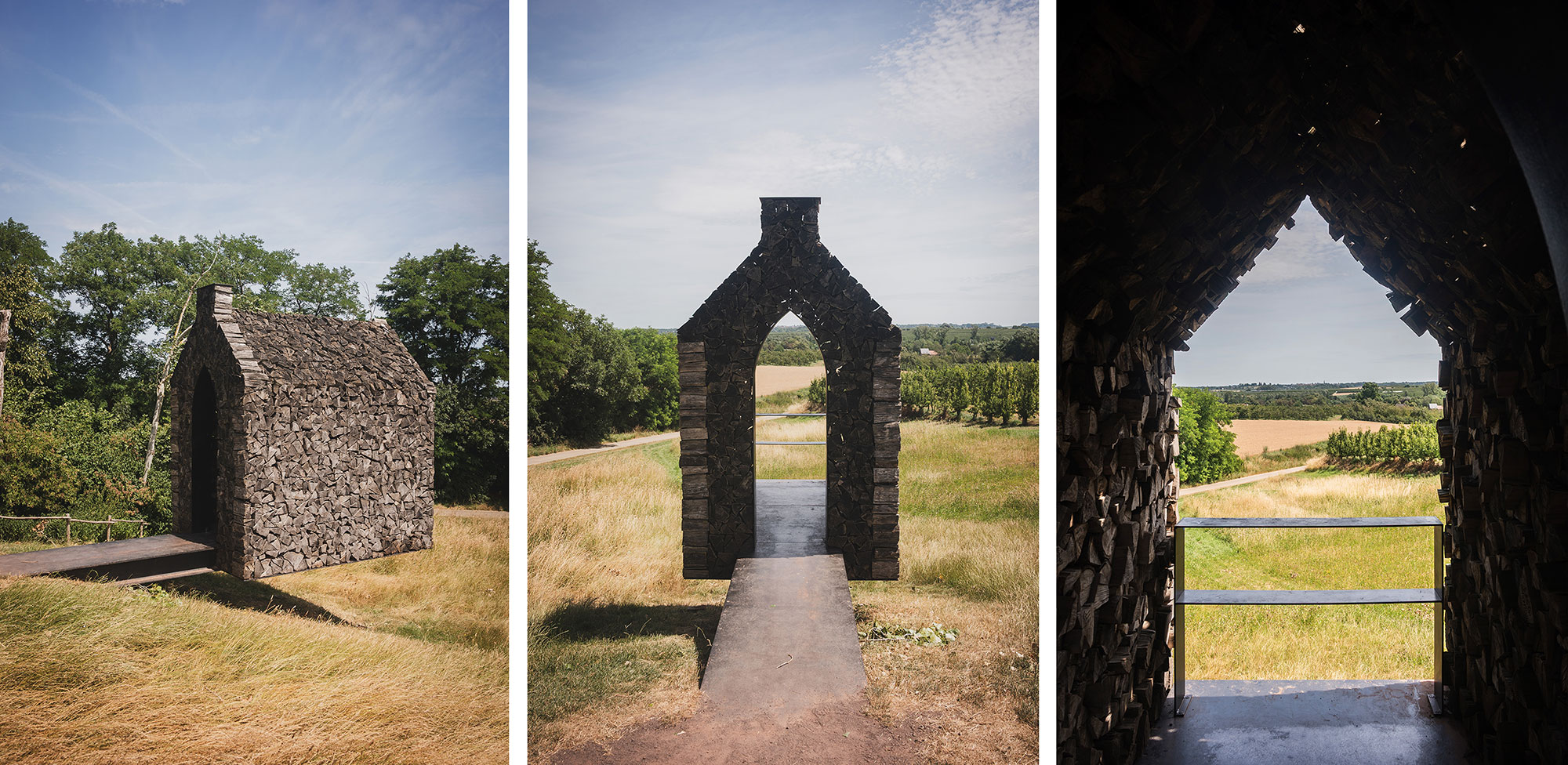
Frits Jeuris. Floating Chapel, Sint-Truiden
By this point, we have spent several days cycling through woods and along country lanes, passing through villages so small that in some we have barely seen another person. That is why arriving in Sint-Truiden comes as something of a surprise. Suddenly, the lively streets and terraces are back, along with a Grote Markt where you immediately feel like parking your bike.
The city grew up around the abbey founded by Saint Trudo in the 7th century and flourished thanks to its location on important trade routes. The tower of the old abbey still dominates the city centre, and from the top you can make out many of its monuments. Nearby, the Church of Our Lady offers one last opportunity to follow the Flemish Masters in Situ trail, while the Franciscan complex houses sculptures, paintings, altarpieces and a 16th-century antiphonary.
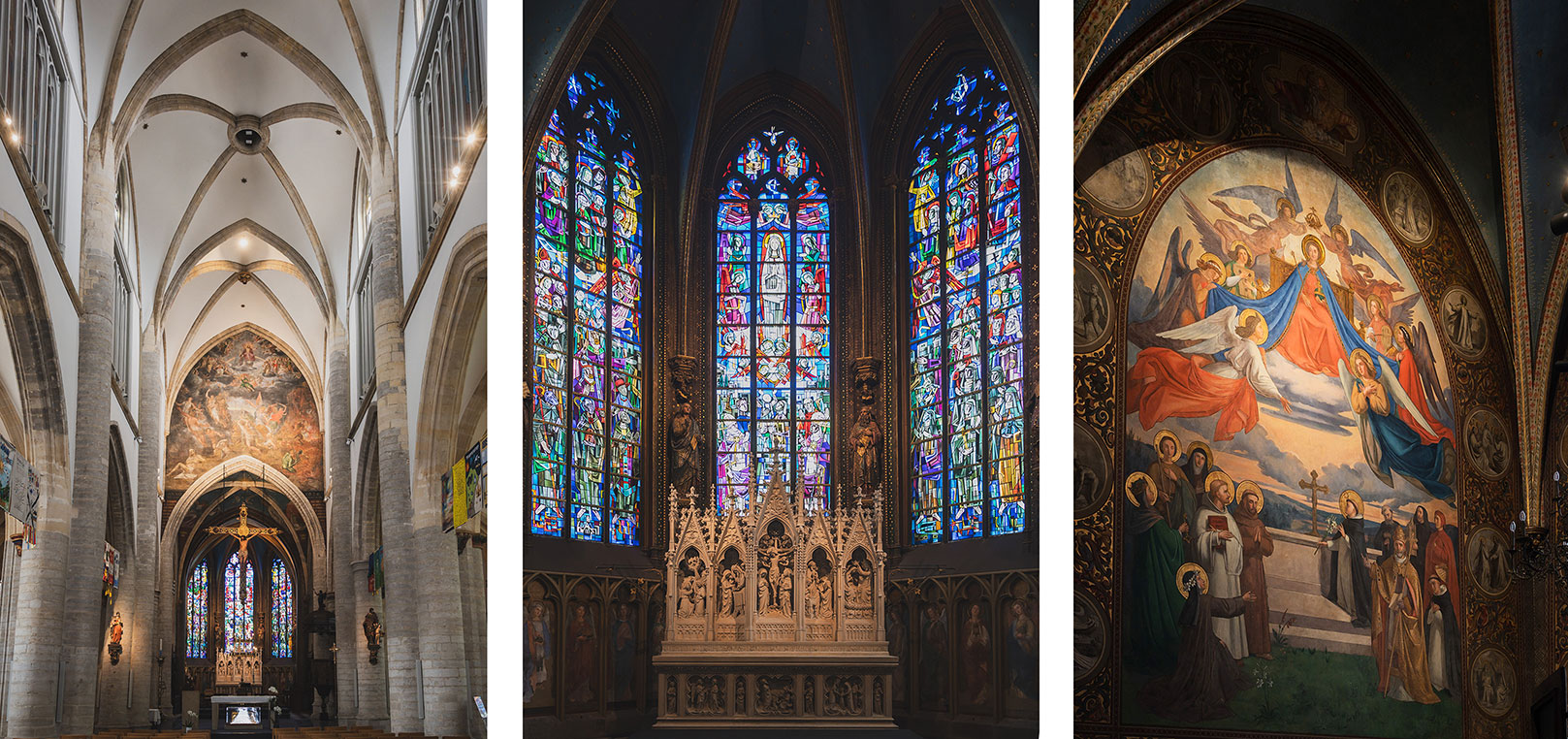
Church of Our Lady. Sint Truiden
This is where our journey ends and it is time to head home. We leave our bikes and return to the train with a rather different feeling from the one we had when we arrived in Hasselt. Limburg does not replace the Flanders of great museums and monumental cities that we all know, but complements it from a different perspective. Here, much of the appeal lies precisely in the fact that everything is more scattered: you have to cycle to a small church to find an altarpiece, cross a former mining area to understand how its landscape has been reinvented, or follow the course of a river to discover contemporary works created specifically for its banks.
Perhaps that is why travelling through the region by bike works so well. Over the course of a few days, we have travelled from the ponds and woods of De Wijers to the mines of Genk; from Hoge Kempen to the Meuse; from a city with Roman origins to the orchards of Haspengouw. And along the way, we have encountered the legacy of the Van Eycks, Flemish altarpieces, archaeology, contemporary architecture, relics, ancient abbeys and sculptures that can only be fully understood when seen in the landscape that surrounds them.
Art has been the perfect excuse to discover Limburg, but we are taking home much more than that. If you feel like following in our footsteps or putting together your own itinerary, remember that the Flanders and Limburg tourism websites offer plenty of useful information to help you make the most of your trip:
https://www.visitflanders.com/es
https://www.visitlimburg.be
© All images accompanying the text, unless otherwise stated: Andrés Valentín-Gamazo